Home Blog Page 9

The 5 Best Salad Spinners & Green Dryers (Tested & Reviewed)

Water acts as a physical barrier against oil-based vinaigrettes. If you attempt to dress wet lettuce, the oil simply slides off the leaves and pools at the bottom of the bowl. Using a high-quality lettuce spinner dryer is the only way to ensure your greens are bone-dry, allowing the flavors to actually stick to your salad instead of wasting money on soggy paper towels.

To properly prep greens, you need mechanical centrifugal force. A kitchen salad spinner rapidly rotates a slotted basket inside a solid outer bowl, forcing the water outward and away from your vegetables. However, manufacturers use vastly different mechanisms to generate that kinetic energy. Based on pump engineering, material durability, and real user feedback, here is the breakdown of the 5 best salad spinners and drying tools for your kitchen.

  • One-Touch OXO Salad Spinner: Did you know that OXO invented the one-touch salad spinner? Its one-handed pump gives you m…
  • What Makes the OXO Salad Spinner OXO Better: This salad spinner has been designed to be the best – from the one-touch pr…
  • Store Salad Spinner Neatly After Use: When you’re done using the spinner as a fruit and vegetable cleaner, press the pum…

1. OXO Good Grips Salad Spinner: The Gold Standard Pump

OXO Good Grips Salad Spinner completely changed the market when they introduced their patented vertical pump mechanism. Instead of cranking a handle, you simply push down on the central plunger. This downward force translates into high-speed horizontal rotation.

Furthermore, pushing downward naturally stabilizes the bowl against the counter, allowing for easy one-handed operation. The built-in brake button instantly stops the heavy internal basket from spinning. While the clear plastic bowl doubles beautifully as a serving dish, the internal gear mechanism can be slightly difficult to deep-clean if small lettuce fragments get trapped inside the lid.
  • HEALTHY MADE EASY: Our Pro Pump Salad Spinner makes it so easy to prepare nutritious foods every night of the week; larg…
  • MULTIPLE USES: This lettuce spinner is more than just a device for quickly rinsing and drying produce; use the basket se…
  • ENOUGH FOR EVERYONE: The generous capacity of our salad spinner (6.65 quart bowl, 5.25 quart basket) means you can put i…

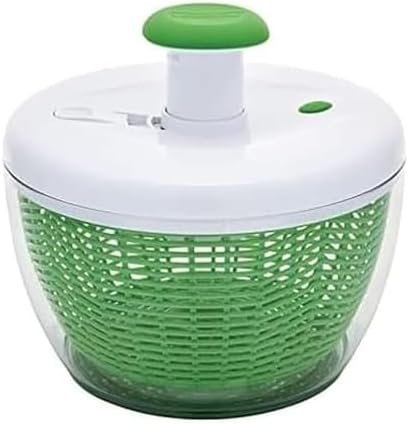
2. Farberware Pro Pump Salad Spinner: The High-Capacity Alternative

If you prep meals for a large family, standard spinners require multiple drying batches. The Farberware Pro Pump solves this volume issue with a massive 6.6-quart outer bowl and a 5.25-quart inner colander.

Mechanically, it functions similarly to the OXO, utilizing a one-handed vertical push pump and an instant brake button. It also features a flat lock-down plunger, which allows you to stack other items on top of it inside the refrigerator. However, as noted in our specific product review, the lid does not fully disassemble. You must carefully flush the top with clean water rather than submerging it in soapy dishwater, otherwise, suds will become trapped inside the sealed gear housing.

  • QUICK & CONVENIENT: Wash and spin-dry salad greens, fruits, and vegetables effortlessly with the Cuisinart 3qt Salad Spi…
  • USER FRIENDLY: Easy-to-use spin knob allows for quick and efficient spinning action. Conveniently add and drain water wi…
  • STABILITY: Non-skid base keeps the bowl stable and prevents any unwanted movement and mess.

3. Cuisinart Salad Spinner: The High-RPM Rotary Crank

Pump mechanisms offer excellent convenience, but traditional rotary cranks generate significantly higher Rotations Per Minute (RPM). The Cuisinart Salad Spinner utilizes a classic horizontal turning handle.

Because you manually control the spin speed, you can crank the handle aggressively to dry heavy, water-logged cabbage, or turn it gently to protect fragile microgreens. Additionally, the lid locks securely into place, preventing the top from flying off during high-speed rotations. You do need two hands to operate it one to hold the base steady and one to crank the handle but it remains one of the most mechanically reliable and compact tools available.
  • LARGE PREMIUM STAINLESS STEEL BOWL: The salad spinner features a large, practical 5.3 quart 304 stainless steel bowl, en…
  • NON-SLIP BASE: The non-slip base keeps the salad mixer firmly planted on the counter, won’t slip while you’re spinning.
  • EXTRA-DRY VEGETABLES: Simply rotate the handle to start spinning the washed salad. You can easily dry your greens, beans…

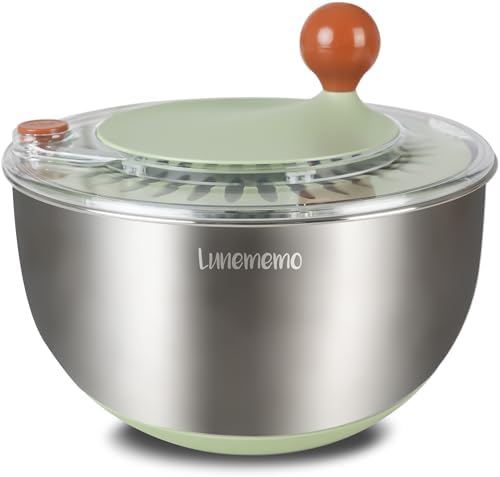
4. Lunememo Stainless Steel Salad Spinner: The Heavy-Duty Hybrid

Lunememo Salad Spinner Review: Premium vs. Plastic heavy centrifugal force creates intense vibrations. Lightweight plastic spinners frequently rattle and slide across wet kitchen counters. Lunememo solves this structural flaw by utilizing a massive 5.3-quart 304 stainless steel outer bowl equipped with a full silicone non-slip ring on the base.

This heavy metal construction completely ignores UV degradation and staining. You can spin your greens dry using the rotary handle, remove the internal plastic colander, and serve your salad directly in the premium steel bowl. It also features a built-in water spout, allowing you to drain the extracted water without ever opening the lid. You pay a premium for the metal exterior, but it easily outlasts standard plastic housing.

  • COMPACT SALAD SPINNER, BIG PERFORMANCE — Small salad spinner packs full-size drying power in a space-saving design. One-…
  • WASH, SPIN & DRY LETTUCE, VEGGIES & FRUIT — A lettuce spinner, vegetable dryer spinner, salad washer, salad dryer & frui…
  • DOUBLES AS A FRUIT WASHER & PRODUCE CLEANER — Removable basket works as a fruit washer spinner bowl. Fill, agitate & lif…

5. The Salad Sling: The Storage-Saving Alternative

Bulky plastic bowls consume massive amounts of cabinet space. If you live in a tiny apartment, dedicating a whole shelf to a salad spinner feels incredibly wasteful. The Salad Sling abandons the plastic bowl entirely.

Instead, this tool utilizes a highly absorbent microfiber towel equipped with a waterproof inner liner and heavy-duty handles. You place your wet greens in the center, gather the handles, and physically swing the sling in a circle with your arm. You act as the motor, generating the centrifugal force manually while the microfiber instantly absorbs the expelled water. It requires physical space to swing and relies entirely on your arm strength, but it folds completely flat, taking up zero cabinet space when not in use.

Matching the Mechanism to Your Kitchen

Ultimately, your choice depends entirely on your grip strength and storage space. If you lack hand strength, the vertical push mechanisms of the OXO or Farberware offer effortless, one-handed drying. If you demand the highest possible RPMs for heavy vegetables, the Cuisinart rotary crank delivers maximum power. If you hate sliding plastic bowls and want a durable serving piece, the Lunememo stainless steel model is structurally unmatched. Finally, if you simply lack cabinet space, the Salad Sling provides the same physical centrifugal force without the bulky plastic footprint.

Lodge Double Dutch Oven Review: The Best Sourdough Pot?

If you want to bake the perfect lodge dutch oven bread, the greatest danger isn’t the dough it’s the 500°F cast iron pot. Traditional Dutch ovens feature deep walls. To bake bread, you must carefully lower your fragile, scored dough down into that screaming-hot cavern without burning your wrists or deflating the loaf. The Lodge 5-Quart Cast Iron Double Dutch Oven completely eliminates this structural danger with a brilliant, inverted design.

  • 2-in-1 Versatile Cookware Design: The Lodge Cast Iron Double Dutch Oven is a Dutch oven and dual-handle skillet in one s…
  • Time-Tested Even Heat Distribution: Designed for uniform cooking, this durable cast iron helps reduce hot spots and reta…
  • Indoor & Outdoor Versatility: Built as a true multi-use iron pot, this oven-safe cooking vessel moves seamlessly from ov…

The “Combo Cooker” Advantage

While Lodge calls this the “Double Dutch,” bread bakers universally know this style as a combo cooker. The genius lies in its two-piece construction. The base is a deep 5-quart pot, but the lid is actually a fully functional, heavy-duty 10.25-inch cast iron skillet.

For sourdough baking, you simply turn the entire system upside down. You use the shallow skillet as your base and the deep pot as your lid (a dome). This inverted method allows you to slide your cold, scored dough directly onto the flat skillet surface. There are no high, dangerously hot walls to navigate. You simply cover the dough with the deep pot, sealing in the steam and protecting your hands entirely.

Bare Iron Thermodynamics

Unlike enameled pots, this Lodge model is constructed entirely of bare, pre-seasoned cast iron. This material choice offers absolute invincibility against thermal shock. Sourdough requires “dry preheating” placing the empty vessel into a 500°F oven for an hour. While this extreme heat can craze or crack budget enamel, bare cast iron absorbs the punishing temperature effortlessly. It acts as a massive 13-pound thermal battery, delivering the immediate, violent heat transfer necessary for explosive oven spring.

Furthermore, bare iron creates an unmatched seal. The heavy skillet-lid sits flush against the deep pot, locking the evaporating moisture inside. This trapped steam keeps the crust soft and expanding during the first twenty minutes of baking.

The Maintenance Trade-Off

The trade-off for this indestructibility is maintenance. Because there is no glass enamel coating, you must maintain the polymerized oil “seasoning” to prevent rust. You cannot soak this pot in soapy water, and you cannot put it in the dishwasher. After baking, you simply wipe it out, apply a micro-thin layer of cooking oil, and store it in a dry place.

User Experience Analysis

This specific inverted design is legendary within the sourdough community. The Lodge Double Dutch boasts an incredible 4.7 out of 5-star rating from over 15,000 reviews, with over 2,000 units sold last month alone. Buyers explicitly purchase this for baking. Verified buyer “Craig B.” stated, “I needed one for sourdough bread and this fits the bill. Just the right size. It is heavy which it should be.”

The Verdict

At roughly $60, the Lodge 5-Quart Double Dutch Oven is arguably the most essential tool a home baker can own. It solves the dangerous wrist-burn problem with its inverted skillet-lid design, and its bare iron construction completely ignores the thermal shock that destroys enameled pots. It requires slightly more maintenance than a glass-coated vessel, but it offers professional-grade steam retention and complete safety for a fraction of the price of luxury brands.

Glass vs Ceramic Cookie Jars: Which One Keeps Cookies Fresh?

When it comes to kitchen storage, glass cookie jars are a classic choice, but are they actually better than ceramic?

The difference is how well the lid seals.

Ceramic jars have a ceramic lid that rests on a ceramic rim. The weight keeps it in place. Air moves in and out through the gap. It’s not open storage, but it’s not airtight either.

Glass jars vary. A glass jar with a glass lid behaves like ceramic. A glass jar with a twist-on lid and a silicone O-ring is airtight. That single design difference changes how long cookies stay fresh.

Cookie Freshness Comparison

Cookie TypeCeramic JarGlass Jar (glass lid)Glass Jar (silicone seal)
Chewy cookies2 to 3 days2 to 3 days4 to 5 days
Crispy cookies4 to 5 days4 to 5 days2 to 3 weeks
AirtightNoNoYes
Dishwasher safeUsuallyYesLid: hand wash
VisibilityNoFullFull

Ceramic and glass jars with glass lids work the same. They slow air exchange but don’t stop it. The glass jar with a silicone seal is different.

Why Ceramic Is Better

Ceramic creates a stable environment inside the jar. It doesn’t let in light, so there’s no UV exposure to affect flavor. Ceramic is also harder to chip or crack than glass. A ceramic jar dropped from counter height often survives. Glass usually doesn’t.

Ceramic looks great in farmhouse kitchens. The glaze, hand-painted details, and warm matte finish stand out. If the jar is on a visible counter and looks matter, ceramic wins.

The Benefits of Using Glass Cookie Jars

Glass wins on two things: visibility and seal quality.

You can see how many cookies are left without lifting the lid. This is a practical advantage for households with kids or multiple people reaching into the jar.

A sealed glass jar with an O-ring lid keeps chewy cookies soft for nearly a week and crispy cookies fresh for close to a month. No ceramic jar matches that.

The Problem with Storing Different Cookies

Many households bake both crispy and chewy cookies. This adds a variable to the jar comparison. Storing two types of cookies in the same jar ruins both. The chewy cookie releases moisture. The crispy cookie absorbs it. Within 24 hours, neither one has the texture it started with.

This is an argument for owning two jars. Two 16 oz glass jars with sealed lids cost less than one large ceramic jar and solve the mixing problem entirely.

How to Decide

If the jar is primarily decorative and your household goes through cookies in two to three days, ceramic does the job. If freshness matters and cookies sit for four to seven days, a glass jar with a silicone seal is the better choice. If you have both types of cookies at once, two separate sealed containers beat any single jar regardless of material.

The right jar isn’t about glass versus ceramic. It’s about matching the container to how you bake and how fast your household eats.

How to Choose the Right Espresso Tamper Size: A Beginner’s Guide

Why Tamper Size Matters (Yes, It Really Does)

When you’re dialing in your espresso setup at home, choosing the right tamper size might not sound like a big deal until you end up with a tamper that doesn’t fit your portafilter. A mismatch can lead to uneven tamping, channeling, and inconsistent espresso shots.

Let’s break it down simply.

What Is Tamper Size?

Tamper size refers to the diameter of the tamper base, typically measured in millimeters (mm). Common sizes range from 49mm to 58.5mm, with 58mm being the most widely used for standard commercial portafilters.

How to Measure Your Portafilter

  1. Remove the basket from your portafilter.
  2. Use a digital caliper (or a simple ruler) to measure the inner diameter of the basket.
  3. Subtract about 0.3mm–0.5mm for a snug fit. That’s your ideal tamper size.

✅ Example: If your basket is 58.4mm wide, a 58mm tamper is your match.

Standard Tamper Sizes (and Where They’re Used)

Tamper SizeCommon Use Case
49mmSmall manual espresso makers (e.g. Flair)
51mmEntry-level espresso machines (De’Longhi)
53mmBreville machines (Bambino, Barista series)
58mmStandard for most prosumer and commercial machines
58.5mmPrecision baskets (tightest fit, requires accuracy)

Precision Fit vs. Wiggle Room

Some home baristas prefer 58.5mm precision tampers for maximum coverage with VST or IMS baskets. Others choose 58mm for ease and flexibility.
If you’re new to espresso, it’s better to go slightly smaller than too snug. Precision tamping demands precise distribution and leveling.


Coffee Accessories on Amazon

A Quick Story from My Own Setup ☕️

I started with a 58mm tamper on my Gaggia Classic. It worked fine, but I noticed minor edge channeling in some shots. I upgraded to a 58.5mm precision tamper and after a brief adjustment period my shots became more balanced and consistent.

It wasn’t magic, but it helped me control one more variable in my setup.

read more: Do You Really Need a Coffee Distributor Tool?

Tips for Buying Your First Tamper

  • Measure first. Don’t guess based on your machine brand.
  • Check basket size. Some machines come with odd-sized baskets.
  • Avoid universal tampers. “One-size-fits-all” usually fits none well.
  • Comfort matters. Look for ergonomic handles and solid weight (300g–500g is a good range).

The closer the fit

Choosing the right tamper size doesn’t have to be complicated but it does matter. The closer the fit, the better the tamping. And the better the tamping, the more consistent your espresso.

A small detail like tamper size can make a surprisingly big difference.

How Coffee Flavor Wheels Help You Taste Like a Pro

If you’ve ever felt lost trying to describe the flavors in your coffee, you’re not alone. Most home baristas can recognize a good cup, but putting the experience into words? That’s where the coffee flavor wheel comes in.

This colorful, flower-like chart isn’t just for professionals it’s an essential tool for anyone who wants to taste coffee with more confidence and clarity.

What is an Espresso Wheel?

While the standard flavor wheel covers all coffee, an espresso wheel is often used by baristas to focus specifically on the intensity, acidity, and mouthfeel of a shot. Whether you are using a standard SCA wheel or a dedicated espresso wheel, the goal is the same: to find the perfect balance in your cup.

What Is the Coffee Flavor Wheel?

The coffee flavor wheel is a visual guide that maps out the wide range of flavors and aromas found in coffee. It was first developed by the Specialty Coffee Association (SCA) and World Coffee Research as a way to help cuppers, roasters, and baristas communicate taste more precisely.

It starts with broad categories like fruity or roasted, then branches into specific descriptors like peach, almond, or burnt sugar.

How to Read It

The wheel is designed to work from the inside out:

  1. Start at the center with general categories like sweet, sour, or nutty.
  2. Move outward as you pinpoint more specific flavors (e.g., sour → citrus → grapefruit).
  3. Use it after a tasting, when you’re trying to describe what you experienced.

You don’t need to get every detail right. The wheel is a tool for discovery, not a test.


Why It Matters

You might wonder: “Do I really need this to enjoy my morning brew?”

If you’re just starting out, maybe not. But if you’re aiming to refine your palate, the coffee flavor wheel can:

  • Train your senses: It helps you focus on subtle flavors you might otherwise overlook.
  • Sharpen your memory: Repeated use builds a flavor vocabulary you can rely on.
  • Guide your purchases: Recognizing your preferred profiles makes it easier to find coffees you’ll love.

Practical Tips for Using the Coffee Flavor Wheel

Here’s how to get the most from it:

  • Taste with focus: Sip your coffee slowly and ask yourself what you’re noticing.
  • Compare multiple coffees: Tasting side by side brings differences into sharper relief.
  • Use your nose: Smell plays a huge role in flavor perception. Swirl, sniff, then sip.
  • Keep notes: Write down your impressions and check them against the wheel.

Over time, you’ll begin recognizing patterns maybe you gravitate toward floral Ethiopians or nutty Latin American roasts.

What We Recommend

To support your flavor exploration, here are some helpful tools:

  • Tasting journals: Great for recording your notes and building flavor memory.
  • Cupping spoons and bowls: Useful for more formal tasting sessions.
  • A printed flavor wheel: Keep one near your brew station for quick reference.

It’s a practica

The coffee flavor wheel isn’t just a fancy chart for professionals it’s a practical, approachable guide for anyone curious about flavor. Whether you’re exploring coffee for the first time or leveling up your tasting skills, this tool will deepen your appreciation of every cup.

So grab your favorite beans, take a slow sip, and let the wheel guide you to a new understanding of coffee.

Vintage-Inspired Silverware Sets

If you are searching for the perfect vintage inspired silverware, you might be thinking of your grandma’s drawer full of tarnished forks. But let me stop you right there this is something completely different.

I’m talking about that perfect blend of old-school charm and modern sensibility. Think soft curves, engraved edges, maybe a brushed finish or a hint of gold at the tip not the kind that feels like you’re eating at a royal wedding, just… thoughtful. Understated. Like you care about the details but don’t want to be the person who polishes cutlery every Sunday.

I picked up a set last fall honestly on a whim, during a sale and I swear it makes even weeknight pasta feel a little fancier. Here’s what I’ve come to love about this style, and a few sets that really stand out.


Why Vintage-Inspired Just Hits Different

  • Texture matters. These sets often have a soft brushed or satin finish that feels good in your hand. Like, not slippery but also not too grippy.
  • Details without drama. You’ll see flourishes tiny engravings, curled handles but nothing screaming for attention.
  • They go with everything. Farmhouse kitchen? Cool. Sleek modern dining table? Still works. That’s the magic.

My Favorite Picks (Right Now)

  1. Sabre Paris Vintage Set – These have a French café vibe. Slightly curved handles, warm silver tones, and they just feel good.
  2. Fortessa Arezzo – Simple, but the hammered texture adds instant personality.
  3. CB2 Brushed Gold Vintage Set – Yes, gold. But muted. Not flashy. Great for dinner parties when you want to be a little extra.
  4. Anthropologie Margot Flatware – Curvy and cute, with floral engravings that are barely there (but you notice).
  5. Lenox Vintage Jewel – A bit more traditional, but surprisingly light. Good for people who want “a little vintage” without going full Downton Abbey.

Also this might sound weird but they photograph beautifully. I’ve had multiple friends ask about mine after I posted a brunch plate on Instagram (yes, it had a fried egg, no, it didn’t look like a magazine shoot, but the fork helped).

So no, these aren’t your grandma’s silverware. Unless your grandma was into timeless design and subtle elegance, in which case… maybe she was just ahead of the curve.

Classic Meals

- Advertisement -