
You are standing in the cleaning aisle, staring at a bottle labeled “dish liquid” and a bar labeled “dish soap.” They both promise to obliterate the greasy residue left behind by your Sunday roast, but are they actually the same thing?

- NEW & IMPROVED FORMULA: New Dawn Platinum is now stronger* on tough grease, so you can spend less time washing dishes (*…
- REMOVES TOUGH GREASE: Dawn Platinum removes 99% of Grease and Food Residue for a squeaky clean you can see and feel
- SCRUB LESS AND CLEAN FASTER*: Dawn Platinum dish soap attracts grease like a magnet so you can scrub less and clean fast…
The short answer is no. If you ask a chemist whether dish liquid is the same as dish soap, they will point out a fundamental difference in molecular structure. One is an ancient chemical reaction; the other is a modern petroleum-derived surfactant. Here is the engineering reality behind what you are using to clean your skillets.
The Myth of Liquid “Soap”
We use the word “soap” as a catch-all term for anything that produces suds and cleans our hands or plates. But true soap is highly specific. It is the result of a chemical process called saponification, where natural fats or oils (like olive oil or beef tallow) are mixed with a strong alkali (like lye). This reaction creates a true soap molecule.
Therefore, that solid block of “dish soap” sitting next to your sink is actually soap. It is brilliant at binding to grease and lifting it away, which is why it has been used for centuries.
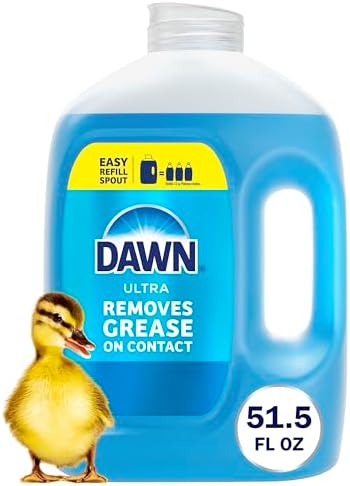
- REMOVES GREASE ON CONTACT: Dawn Ultra packs a powerful punch of grease-fighting power for a deep, sparkling clean
- REFILL WITHOUT THE SPILL: Our new and improved jug features an easy-pour spout and comfortable handle to make refilling …
- SAME CLEAN, BETTER VALUE: Save money* and save plastic when refilling with our dish soap refill jug (*when comparing $/o…
However, that squirt bottle of Dawn or Palmolive sitting on your counter? It contains absolutely zero soap.
The Engineering Reality: Surfactants and Hard Water
Dish liquid is technically a synthetic detergent. Instead of relying on saponified fats, manufacturers build these liquids using complex synthetic surfactants (surface-active agents), often derived from petrochemicals or highly processed plant oils.
Why did we move away from true soap for washing dishes? The answer lies in the physics of your local water supply. True soap reacts terribly with the dissolved minerals (calcium and magnesium) found in “hard water.” When soap molecules meet these minerals, they instantly bond and form soap scum a sticky, insoluble film that coats your glasses and leaves them looking cloudy.
Synthetic dish liquids were engineered specifically to ignore these minerals. The surfactants in dish liquid cut through heavy grease and rinse away perfectly clean, regardless of how hard your tap water is.
User Experience Analysis: When to Use Which
The choice between traditional dish soap and modern dish liquid dramatically alters your cleanup workflow.
Users who switch to solid dish soap often praise its environmental benefits. User Sarah T. noted, “I switched to a solid dish soap bar to cut down on plastic bottle waste, and it cleans my lightly soiled plates beautifully.” However, users also frequently report frustration when tackling heavy, baked-on messes, finding that true soap requires significantly more mechanical scrubbing power to break down stubborn animal fats.
Conversely, synthetic dish liquids are aggressive degreasers. They are formulated to break the surface tension of water instantly, allowing the liquid to penetrate and lift polymerized oils off a stainless steel pan with minimal elbow grease. The trade-off is that these highly concentrated synthetic detergents can be harsh on human skin, stripping away natural oils and leading to cracked hands during heavy winter prep sessions.
Choosing Your Degreasing Agent
If you live in an area with very soft water, are passionate about eliminating single-use plastics, and primarily wash lightly soiled plates, a traditional solid dish soap bar is a fantastic, eco-friendly option.
However, if you routinely wrestle with heavily greased cast iron skillets, deal with hard tap water, and demand spotless, streak-free glassware, synthetic dish liquid remains the undisputed champion of the modern kitchen sink.








[…] this is going to be a genuine conversation have you ever grabbed your dish soap and gone, “What in the world is that?” I did. I was refilling my detergent dispenser […]