Home Blog Page 61

Do Espresso Tampers Make a Difference? Myths vs. Facts

The Big Question: Does Your Tamper Really Matter?

If you’ve spent any time in coffee forums or watched espresso tutorials, you’ve likely heard all sorts of opinions about tampers. Some say any heavy flat object will do. Others treat tampers like precision surgical instruments. So. what’s the truth?

Let’s separate the myths from the facts and see what actually impacts your espresso quality.

Myth #1: All Tampers Are Basically the Same

❌ The Myth:

As long as it’s compact enough to fit your portafilter, it doesn’t matter.

✅ The Reality:

Consistency and fit do matter. A tamper that is too small will leave holes, resulting in channeling. A tamper that fits well and exerts even pressure ensures even extraction.

Myth #2: You Must Use Exactly 30 Pounds of Pressure

❌ The Myth:

Measure with a scale, or you’re doing it incorrectly.

✅ The Reality:

And though 30 pounds is a common recommendation, it’s force versus consistency. Don’t care if it’s 20 or 40 pounds; do it consistently every time. Your muscle memory is your best buddy.

Myth #3: High-Price Tampers Pull Better Espresso

❌ The Myth:

It’s more expensive, therefore it must be better.

✅ The Reality:

Price reflects build quality, not flavor. A well-built $30 tamper can produce equal to or even superior to a $150 designer tamper. Comfort, heaviness, and fit more than a label are desirable over a label.

Myth #4: Calibrated Tampers Are Just Marketing

❌ The Myth:

They’re unnecessary and gimmicky.

✅ The Reality:

While not required, calibrated tampers are useful—especially for the novice user or multi-user families. They help to enforce consistent technique and prevent over- or under-tamping.

Myth #5: Tamping Is the Most Important Factor in Espresso

❌ The Myth:
Tamping makes and breaks your shot.

✅ The Reality:
Tamping is involved. Grind size, dose, distribution, and water temperature have a larger influence. A perfect tamp will not fix a sub-dialed grind.

Personal Note ☕️

When I first was pulling shots at home, I was using the thin plastic tamper that the manufacturer included with my machine. My shots were completely inconsistent. When I finally made the change to a metal tamper that fit my basket properly, the impact was immediate—not in the way the coffee tasted, but in the way the shots extracted and had crema.

Would I say that a good tamper changed my life? No.
Would I go back to that plastic puck? No either.

So, Do Tampers Make a Difference?

Yes but not on their own.
The right tamper makes for a consistent environment for the rest of your variables to thrive. It’s not magic, it’s reliability.

If you’re committed to espresso in the home, investing in a good tamper isn’t hype it’s smart workflow optimization.

read more: The Importance of a Tamping Mat in Your Espresso Setup

Coffee Accessories on Amazon

How to Control Coffee Bloom for Consistent Flavor: A Home Brewer’s Guide

If you’ve made coffee and seen those fizzy reactions at the start, you’ve already seen coffee bloom in action. Yet here’s a little-known fact: you can actually control the bloom to get more consistent, more flavorful, and better-balanced brews.

Let’s explore how simple changes to your routine can give you more mastery over bloom and more tasty coffee, cup after cup.

Why You’d Want to Control Coffee Bloom

Coffee bloom is not only a visual phenomenon. It directly impacts:

Extraction (how evenly flavors are extracted)

Consistency (how consistent your brews are)

Flavor clarity (how “clean” your cup tastes)

By tuning in a few variables, you can ensure every brew gets the full benefits of blooming especially handy if you’re switching beans a lot or dialing in a new method.

  1. Grind Size: Start with the Basics

The finer you grind, the faster CO₂ is released but also the more water flow will tend to be uneven.

Too fine? You’ll get a fast bloom and perhaps channeling.

Too coarse? You may not degas enough and under-extract.

Tip: For pour-over and AeroPress, medium grind is usually best. If bloom is too aggressive, try coarsening a bit.

  1. Roast Date and Freshness Matter

Recently roasted coffee (within 2–3 weeks) blooms more intensely due to higher gas content.

If you’re dealing with super fresh beans (like within 3–5 days post-roast), bloom can be explosive.

If the coffee is too old, bloom can be flat or nonexistent—time to buy fresh.

Pro Tip: Let coffee rest for 5–7 days after roasting for a more controlled bloom.

  1. Water Temperature

Higher temperatures (near 200°F / 93°C) accelerate CO₂ release. Lower temperatures slow down the bloom but also risk weak extraction.

Ideal range: 195–205°F (90–96°C)

For consistency, use a thermometer or adjustable temperature kettle.

  1. Bloom Ratio: How Much Water to Add?

A rule of thumb is to use approximately 2x the coffee weight in grams. For example:

15g coffee → 30g water for bloom

But here’s the trick: adjust slightly based on roast level.

Dark roast? Employ a bit less water (1.5x) to avoid over-degassing.

Light roast? Use 2x or even a bit more—these beans need more help.

‍Monitor your bloom time, too: 30–45 seconds is usually just right.

  1. Even Pouring = Even Bloom

Pour in circles and slowly, starting at the middle and moving outward. This enables even saturation and dissuades dry pockets, which can throw off the balance of the whole brew.

Don’t pour water all at once—it’ll create uneven bloom and messy extraction.

Bonus: Bloom as a Diagnostic Tool

Did your bloom behave strangely? Use it as feedback:

Collapsed too soon? Your beans are probably stale.

No bloom? Possibly pre-ground coffee or bad storage.

Uneven bubbling? Your grind size or distribution is probably off.

Paying attention to these things can be used to diagnose your entire coffee process.

By controlling grind

Control of the coffee bloom might sound like a trick for professionals, but it’s surprisingly easy and effective. By controlling grind, freshness, water, and pour, you can have more control over the taste of your coffee.

As a home barista, this is one of those “small change, big difference” techniques. When you brew next, try altering one thing in your bloom and taste the difference.

Coffee Accessories on Amazon

How Coffee Bloom Affects Extraction: The Science Behind the Bubbles

When you brew coffee and see that attractive puff of bubbles at the start what is known as the coffee bloom it’s not merely aesthetic. That initial fizz is a crucial component of the extraction. So, what does bloom do to the way your coffee tastes?

Let us deconstruct the physics of coffee bloom and how knowing about it will help you extract the optimal flavor from your brew.

What’s Really Happening During the Bloom?

When you first pour hot water over freshly ground coffee, it releases trapped gases—mostly carbon dioxide (CO₂)—from the coffee. The gases formed during roasting and are stored in the beans until you grind them. When the CO₂ is released, it creates bubbles and expansion: the coffee “blooms.”

This is important chemically since CO₂ resists water flow. If not removed before complete brewing, it will repel water and lead to uneven extraction. Uneven extraction normally translates to sour, underdeveloped, or flat-tasting coffee.

Why Extraction Matters

Extraction is the process by which water extracts flavors, oils, and substances from ground coffee. For a balanced cup, this needs to be even and complete. This is how blooming assists:

Reduces resistance: Allowing CO₂ out early, water can then flow freely and access all coffee particles on equal terms.

Improves consistency: Less gas means there are fewer air pockets disrupting flow, so the saturation is even.

Enhances flavor clarity: Proper blooming permits the extraction of the bright acids first, followed by body and sweetness, in a layered flavor.

Without bloom, water can channel through some grounds and over-extract others, creating harsh or muddled flavors.

Brewing Methods Where Bloom Impacts Extraction Most

Certain brewing methods more directly benefit from blooming:

Pour-Over (e.g., Hario V60 or Chemex): The bloom stage controls how evenly the coffee bed becomes saturated. Without it, there’s a risk of channeling.

French Press: Blooming pre-saturates grounds to aid in even immersion during steeping.

AeroPress: In recipes with blooming steps, you reduce trapped gas that can influence pressure or flow.

Even some automatic drip machines feature “pre-infusion” settings that mimic blooming—proof of its necessity.

How to Bloom for Better Extraction

If you’re serious about your cup, do the following when blooming:

Use freshly roasted coffee beans – ideally within 2–3 weeks of roasting.

Grind just before brewing to keep trapped gases intact.

Add water slowly – about twice the weight of your grounds. Pour gently and evenly.

Wait 30–45 seconds before continuing. This allows for complete degassing.

Continue brewing normally, knowing now that your extraction will be more even.

Its impact on extraction is enormous

Coffee bloom is a small step in the brewing process, but its impact on extraction is enormous. It sets the stage for hot water to interact correctly with coffee grounds and leads to better flavor and consistency in every cup.

So the next time you’re brewing, especially with manual methods, don’t skip the bloom.

Coffee Accessories on Amazon

Espresso Tampers 101: Why This Small Tool Makes a Big Difference

I remember when I first bought my espresso machine. I really believed I had everything planned out: the beans, my grinder, and my trusty machine. But I could never get my shots to feel just right.

So, what happened? I got a new tamper.

The basket was a bit too big, and I just couldn’t keep a steady squeeze on it. When you’re getting serious about espresso equipment, make sure you don’t forget the tamper. It’s a small thing, but it’s really important for making coffee that tastes like it came from a nice café, right in your own kitchen.

Let’s figure out what’s suitable for you.

What Does a Tamper Actually Do?

A tamper basically just presses things down. It’s a simple tool, usually with a flat, heavy bottom and a handle, that you use to pack stuff tightly. It pushes the material together, getting rid of air pockets and making it more solid.

When you tamp, you’re just pressing the coffee grounds in your portafilter into a nice, flat “puck.” This is what gives us the needed resistance to handle 9 bars of water pressure.

  • Resistance: A good tamp makes it harder for water to get through the coffee. This stops it from rushing through too fast (under-extracted).
  • Even Flavor: It makes sure everything gets flavored just right, so each sip tastes balanced.
  • Preventing Channeling: If your coffee puck isn’t perfectly level when you tamp it, the water will find the easiest path, rushing through those weak spots and messing up your whole shot.

Tamper Size: Why Precision Matters

Tamper diameters are typically around 49mm to 58.5mm. This is one of those specs we really need to nail.

  • Home Machines: For brands like De’Longhi or Breville/Sage, you’ll typically find portafilter sizes are either 51mm or 54mm.
  • Prosumer Machines: For commercial machines (like Gaggia, Rocket, or ECM), you’ll typically find that the baskets are 58mm.

Important: It’s a good idea to measure your basket’s size before you buy anything else for it. If your tamper is too small for the basket (like a 51mm tamper in a 58mm basket), you’ll end up with grounds around the edges that don’t get pressed down. This usually makes the coffee taste sour.

Flat Base vs. Convex Base: Which One To Use?

  • Flat Base: This makes sure your puck is totally flat. This is the go-to if you want true accuracy, which is why you see it so much in prosumer kitchens and cool coffee shops.
  • Convex Base: This is just a little bit curved, kind of like it’s got a small bump. This pushes the coffee to the edges, which might help seal the puck if your basket is tapered.

The Bottom Line: If you’re a home barista, a Flat Base is usually your best bet unless you have a strange basket situation.

Handle Ergonomics: Comfort Affects Consistency

It might seem like a simple thing to tamp your coffee grounds, but if you do it wrong every day, you could end up with wrist strain (what some folks call “Barista Wrist”).

  • Material: Wood feels good and warm. Aluminum gives you that precise feeling. Rubber is all about the grip.
  • Balance: Having a heavy base and a light handle makes it feel much more stable than if the tamper were top-heavy.

Make sure the handle fits nicely in your hand. You want your tamper to feel just right, like it’s a natural part of your arm, not some awkward thing you’re fighting with.

Should You Switch to a Calibrated Tamper?

Calibrated tampers actually have a spring inside them. They click, or just stop squishing down, when you’ve hit a certain pressure (usually around 25-30 pounds).

They are really good for:

  1. Beginners who aren’t quite sure what “30 lbs of pressure” actually means.
  2. Consistency so all your shots look right together.
  3. Peace of Mind to prevent over-tamping or under-tamping.

They’re not a must-have, but they definitely help you relax, especially when you’re really trying to get things perfect.

Recommended Espresso Tampers

TamperBest ForNotes
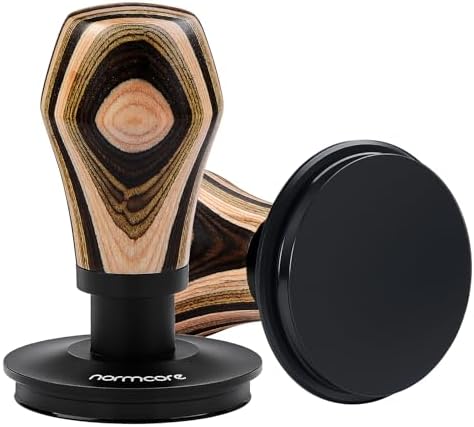
Normcore V4 CalibratedBeginnersAdjustable pressure springs and levels itself.
Matow Dual-HeadSmall SetupsBundles a distributor and a tamper all into one tool.
Motta 58.4mmProsumersHeavy, flat base with that classic Italian design.
LuxHaus CalibratedBudgetStraightforward, dependable, and simple to use.

The Bottom Line

You might not really think about your tamper very often, but a bad fit or an uneven one can seriously mess up your espresso without you even realizing it. If you pick the correct size and shape, your tamper will make each tamp consistent, which means your espresso shots will taste way better.

When you’re brewing another one, try asking yourself: Is the pressure even? Is my puck straight? The answer is in your hands.

Coffee Accessories on Amazon

How to Choose the Right Coffee Grinder for Your Brewing Style

If you’ve ever brewed coffee at home and felt something was off, chances are your grinder might be the culprit. Choosing the right coffee grinder isn’t just about price or looks it’s about matching the grinder to your brewing method.

I still remember my first grinder: whirring, clattering blade contraption that produced a mixture of powder and chunks. My coffee? Unreliable, stale, sometimes downright sour. Once I swapped that out for a burr grinder made especially for my pour-over gear, the results were immediate. Let’s make sure you skip that rough start.

  1. Blade vs. Burr Grinder: What’s the Difference?

Blade grinders cut beans irregularly. They’re inexpensive but generate uneven particle sizes, which can impair flavor negatively.

Burr grinders grind beans against two rough surfaces. This produces uniform grind size, which is important for even extraction.

Affiliate Tip: As a beginner, a budget burr grinder such as the Baratza Encore is a good option. It’s easy to use and well-suited to manual brewing techniques.

  1. Match Your Grinder to Your Brew Method

Different brewing methods need different grind sizes. Here’s a quick cheat sheet:

Brew MethodIdeal Grind TypeGrinder RecommendationFrench PressCoarseManual burr grinderPour-Over (V60)Medium-FineElectric burr grinder with settingsAeroPressMedium to FineAdjustable hand grinderEspressoFine and ConsistentEspresso-specific burr grinderCold BrewExtra CoarseBurr grinder with coarse range

Note: For espresso, avoid general-use grinders. You’ll need something with micro-adjustments like the Fellow Opus or Eureka Mignon.

  1. Manual vs. Electric: What Fits Your Routine?

Manual grinders are quiet, light, and great for travel or a single serving. But you’ll have to earn it—mini workout in the morning.

Electric grinders are the way to go if you desire speed and convenience. Higher end grinders enable grind size adjustment, timed dosing, and quieter operation.

Ask yourself: Do I make coffee for one person or a family? Do I want quiet or speed in the morning?

  1. Burr Material: Steel vs. Ceramic

Steel burrs are sharper, faster, and standard in premium grinders.

Ceramic burrs stay sharp for longer and generate less heat, aiding in flavor preservation.

For heavy day-to-day use, either will suffice but steel is more standard in modern, reliable models.

  1. Think About the Long Term: Maintenance and Durability

Low-end grinders burn out fast. Look for models with:

Replaceable burrs

Simple-to-clean components

Strong warranty and support

Affiliate Tip: Include a grinder cleaning brush in your kit cleaning your grinder extends its life and improves flavor.

Last Thoughts

A great coffee grinder is the backbone of every brewing setup. Think of it as a long-term investment not just in gear, but in flavor. Match it to your brew style, choose quality over convenience, and you’ll taste the difference in every cup.

read more: How an Espresso Shot Glass Can Improve Your Brewing Precision

Coffee Accessories on Amazon

Flat vs. Convex Espresso Tampers: Which One Should You Use?

Why Tamper Shape Matters More Than You Think

Once you’ve already determined the size of your tamper, there’s one other aspect that might trap you in: the shape of your tamper base. Is it flat or convex? It’s a small detail that will actually make a big impact to how your coffee extracts.

Let’s take a closer look so you don’t have to waste time second-guessing your gear.

Related article: Do You Really Need a Coffee Distributor Tool?

What’s the Difference?

FeatureFlat TamperConvex TamperShapeCompletely flat baseSlightly rounded, dome-shaped basePressure SpreadEven across the surfaceConcentrated in the centerChanneling RiskLow if distribution is perfect. Can reduce edge channeling in some casesSkill Required. Best for users with even distribution. More forgiving with puck prep

Flat Tampers: The Classic Standard

Most baristas especially in specialty cafes use flat tampers. With even distribution and tamp level, a flat base gives even resistance everywhere on the puck, which supports balanced extraction.

Flat tampers are ideal if:

You’re using a precision basket (like VST or IMS).

Your puck prep is clean and consistent.

You want full control over the tamping process.

Convex Tampers: A Forgiving Friend

Convex tampers have a slight dome that presses more toward the center of the puck. This can help minimize edge channeling, especially if your distribution isn’t perfect.

Convex tampers may work well for:

Beginners who are still refining their tamping technique.

Pressurized or non-standard baskets.

Equipment with non-uniform water dispersion.

Small Tip: Some budget espresso machines are assisted by convex tampers due to uneven shower screens.

So… Which One Do You Need?

Here’s a simple method for making up your mind:

✅ Go flat if you’re working with a standard or precision machine and want greater control.

✅ Go convex if you’re a newbie or with lower-end gear.

Technique is more crucial than tamper form in the end—but an accommodating tool will allow you to figure it out faster.

A Personal Aside on Shifting from Convex to Flat

I started off with a Breville Bambino and used a convex tamper to mask over my distribution deficit. And it was great. But when I switched to a Gaggia with a bottomless portafilter, I shifted to flat and could tell I was getting it wrong.

The upgrade wasn’t just about gear. It also instructed me to level up my prep, as well.

What’s best for your gear and technique skill set

There’s no such thing as the absolute perfect tamper shape only what’s best for your gear and technique skill set. If possible, try both. But don’t let this small detail hold you back from forging ahead on your espresso adventure.

Coffee Accessories on Amazon

Classic Meals

Do Satin Silverware Sets Show Water Spots?

In our previous article, we explored whether satin silverware sets are suitable for daily use. We recommend checking out that piece. In this article,...
- Advertisement -