Home Blog Page 46

Santoku vs. Chef’s Knife: Which Blade Shape is Best for General Use?

For anyone putting together a functional kitchen, the choice of the main all-purpose knife often comes down to two iconic shapes: the Western Chef’s knife, otherwise known as gyuto, and the Japanese Santoku. Both are for chopping, slicing, and dicing, but the different geometries mean these knives offer very different cutting styles. Deciding between Santoku vs. Chef’s Knife depends heavily on your preferred way of cutting and the types of food you prepare most frequently.

Compare the feel and balance of both classic chef’s knives and Santoku models:

The Chef’s Knife: Rocking and Slicing

The classic Western chef’s knife has a very pronounced curve that follows the belly of the blade down to a sharp, pointed tip.

  • Expertise: This curved profile is specifically designed for the rocking motion where the tip remains on the cutting board while the rest of the blade moves up and down. This motion is efficient in mincing herbs and swiftly dicing vegetables. The sharp, pointed tip is ideal for piercing and doing fine work, such as trimming meat or making precision cuts.
  • Versatility: The chef’s knife, with its blade lengths, often ranging from 8 to 10 inches, provides ample knuckle clearance and is capable of handling larger tasks, making it the globally accepted workhorse of the kitchen.

The Santoku: Chopping and Efficiency

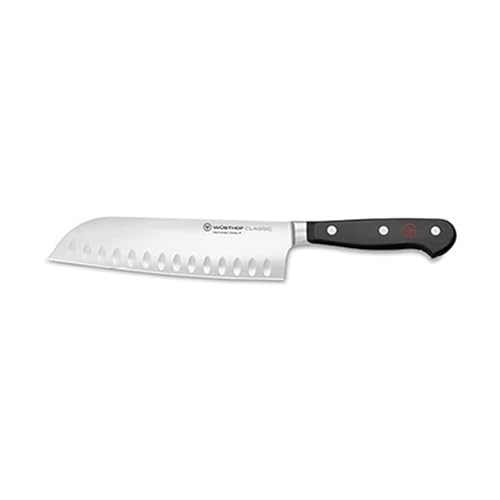
The Santoku, whose name means “three virtues” for the three foods with which it is used meat, fish, and vegetables offers a flatter cutting edge combined with a spine that slopes downward to meet the edge at a rounded tip.

  • Authoritativeness: The flat profile encourages a chopping motion where the blade is lifted straight up and down rather than the Western rocking action. This motion is great for processing vegetables in rapid succession and is preferred by many cooks who like to have more control during vertical cuts. The shorter blade, normally 6 or 7 inches, allows for better maneuverability.
  • The Granton Edge: Many Santoku knives have a Granton edge, which is small indentations near the edge. These create air pockets that help greatly reduce sticking when slicing starchy or moist foods like potatoes or cured meats a key advantage when considering Santoku vs. Chef’s Knife.

Choosing Your Style: Santoku vs Chef’s Knife

They’re both great for general home use. The decision largely depends on your technique. If you do a rocking motion most of the time, then the Chef’s knife is an extension of your arm. If you like the straight vertical chop and like a lighter, shorter blade for quicker prep, the Santoku is very suitable.

read more: Victorinox Fibrox Pro: Why This Chef’s Knife is the Industry Standard

The Guide to Knife Steel Hardness (HRC Rating) and Edge Retention

There is a carefully selected piece of steel behind every sharp knife, and its performance relies on a critical measure: hardness measured under the Rockwell Hardness Scale. HRC Rating Edge Retention directly indicates, without any doubt, how long a knife will remain sharp, whether it will be easy to sharpen, and whether it is resistant to damage or not. For anyone investing in quality cutlery, understanding this balance is key to choosing a blade that truly meets their culinary demands.

Examine knives made from a variety of different HRC ratings to find your perfect balance of hardness vs. toughness:

Understanding the HRC Scale: Hardness Defined

The Rockwell Hardness C scale, or HRC, is a common measurement for the resistance of a material to permanent indentation. In knife steel, a higher HRC number refers to a harder steel.

  • Expertise: Most kitchen knives fall between an HRC rating of 54 to 64. A rating of 54–56 HRC is the common rating for softer, tougher Western-style knives, and that of 60–64 HRC for harder, more brittle Japanese-style knives. This quantifiable metric forms the basis for discussions around HRC Rating Edge Retention.

Edge Retention: The Hardness Advantage

Generally, the harder the steel is, the better the edge retention will be. A very hard blade resists the microscopic rolling and dulling that occurs with use, allowing it to keep its sharp edge longer.

  • Authoritativeness: This is why premium Japanese knives, often hardened to 62+ HRC, are celebrated for their ability to maintain a razor-sharp edge through extensive slicing. However, this benefit comes with an important trade-off.

Toughness and Brittleness: The HRC Paradox

Hardness and toughness are inversely related. While a very hard knife holds an edge exceptionally well, it is also more brittle.

  • Experience & Trust: Softer steels are tougher, which means that they can flex and absorb impact without chipping. A 56 HRC German chef’s knife may not hold its sharpness as long as a 62 HRC Japanese gyuto, but it is far less likely to chip if it is dropped or twisted accidentally. That said, the 62 HRC blade, while a marvel of slicing ability, requires delicate handling; impact against a bone or a drop onto a tile floor is likely to result in irreparable chips. In this regard, for a comprehensive guide to HRC Rating Edge Retention, it is important to understand this balance.

Sharpenability: The Impact on Maintenance

The HRC rating also directly affects how easily a knife is sharpened. Softer steels are quicker and easier to sharpen using basic tools, while harder steels require more abrasive (often diamond) sharpening surfaces and more skill. This means a higher HRC might reduce sharpening frequency, but increase sharpening difficulty.

Conclusion: Finding Your Balance

There is no one “best” HRC; the optimal hardness completely depends on a cook’s technique, his willingness for meticulous care, and his intended use. The HRC Rating Edge Retention guide helps you choose wisely.

Read more: Boning Knife vs. Fillet Knife: Which to Use and Our Top Picks

Understanding Blade Geometry: Flat Grind vs. Hollow Grind, and How It Affects Cutting

But a knife doesn’t just cut food because it’s sharp; its geometry or “grind” the shape of its cross-section determines the way it slices through food. The choice between a Flat Grind and a Hollow Grind dramatically changes the blade’s strength, sharpness, and resistance when attempting to cut through dense or delicate materials. Understanding these geometries is crucial for selecting the right knife for particular tasks in the kitchen.

Find knives with both flat and hollow grinds and compare the feel of them:

Flat Grind: The Versatile Workhorse

The flat grind or V-grind tapers evenly from the spine, which is the thickest part, right down to the cutting edge, providing a profile that is both structurally robust and highly versatile.

  • Expertise: With this flat grind, because the material remains relatively thick until the very edge, it allows for exceptional lateral stability and strength. Such a profile would be common on robust chef’s knives and utility blades intended for daily, general-purpose work when the knife needs to stand up to some twisting or to heavy-duty cutting, like slicing through dense vegetables or meat with small bones.
  • Cutting Action: The flat grind pushes the material away from the blade quickly, reducing friction and prevents sticking when slicing moist foods like cucumbers or potatoes.

Hollow Grind: Extreme, Delicate Sharpness

The hollow grind is easily recognizable: the sides of the blade feature a concave, scooped-out curve before reaching the edge. This geometry results in an incredibly thin area just behind the cutting edge.

  • Authoritativeness: The primary benefit is extreme sharpness and minimal resistance. The concave profile means the cutting edge is far thinner compared to that of a flat grind, so the knife can cut very delicate items like smoked salmon or roast beef with very little drag. This is the geometry of choice for professional straight razors, testament to its slicing capability.
  • Trade-Off: The extreme thinness, on the other hand, comes at a price in durability. The narrow profile behind the edge is structurally weaker and prone to chipping or rolling when it meets hard materials.

Which Geometry Affects Cutting: Practical Application

The main difference between Flat Grind vs Hollow Grind manifests when resistance is encountered.

  • Flat Grind: Great for splitting and chopping, its mass wedges through items like carrots or winter squash. Great for general prep.
  • Hollow Grind: Great for light slicing and precision cuts the thinness reduces friction. Ideal use: presentation cuts or filleting. To the home cook, though a hollow grind may feel razor sharp, a flat grind usually offers the needed durability for the demanding and varied tasks of a busy kitchen.

read more: The Top 10 Chef’s Knives Under $70 (Expert Reviews)

How to Fix a Dull Edge: Removing Chips and Restoring the Blade Geometry

A truly dull knife is more than just frustrating; it’s dangerous. When your blade has lost its bite, or worse, developed unsightly chips, it clearly indicates that honing is no longer good enough; you need to actively take away material and reform the cutting edge. Fix a Dull Edge Removing Chips is a fundamental skill for any serious cook, taking a seemingly ruined blade back into a precision cutting tool by way of restoring its original geometry.

Ready to put life back into those dull knives? Explore sharpening stones and more, right here:

Chip Depth: Assessing the Damage

Before beginning, take a close look at the blade: small nicks or an edge that is generally rounded calls for less vigorous grinding. With deeper chips, more time and material must be taken away.

  • Expertise: It is not simply a matter of removing the chip but of putting a new, consistent apex the very tip of the cutting edge above the deepest point of the damage. This generally involves grinding down the entire edge slightly in order to maintain a uniform profile, which is so critical for the Fix a Dull Edge Removing Chips procedure.

The Right Tools: Coarse Grit First

For serious dullness or chips, you have to begin with a coarse sharpening stone, generally in the range of 200-grit to 400-grit. The aggressive grit takes off metal quickly and efficiently.

  • Authoritativeness: It is useless to try to sharpen a really dull or chipped blade with fine grit; it will take way too much time and effort without ever truly re-forming the edge. Any respected professional knife maker always states that one must start coarse in order to establish the new geometry. Waterstones provide the perfect lubrication when properly soaked for this process, preventing overheating and assuring effective material removal.

Restoring Geometry: Consistent Angle is Key

This is where the true sharpening skill comes in: you need to be able to hold a knife at your desired sharpening angle let’s say 15 to 20 degrees per side for Western knives consistently while moving the blade across the stone.

  • Experience & Trust: Concentrate your efforts on grinding away the shoulders of the blade until the entire cutting edge intersects with the stone above the deepest chip. The motion should be smooth and controlled, using the full length of the stone. You’ll know you’re making progress when you see a consistent slurry forming and, eventually, feel a burr (a tiny wire-like edge) along the opposite side of the blade. The burr signals that you’ve ground all the way through and established a new apex essential for fixing a dull edge by removing chips.

Refining the Edge: Progressing to Finer Grits

Once the new geometry has been set and the burr is present, start moving up to finer grit stones 1000, 3000, 6000-grit to refine the edge and remove the burr, resulting in a razor-sharp, mirror-polished finish.

read more: Mastering the Whetstone: A Step-by-Step Guide to Consistent Sharpening Angles

Electric Knife Sharpeners: Are They Safe for High-Quality Chef’s Knives?

But there’s a clear appeal in the idea of an electric knife sharpener: speed and ease of use, slight skill involvement. To the occasional cook who finds whetstones and honing steels intimidating, these machines are a godsend. Yet if you value your high-quality chef’s knife, you’ll probably wonder if the electric sharpeners won’t damage your expensive blades. You will reach the truth by learning about how Electric Knife Sharpeners work and also High-Quality Chef’s Knives.

Get a quality electric sharpener that does not abuse your blades: Check the top-rated models here:

How Electric Sharpeners Work: Abrasive Action

Most electric sharpeners use abrasive wheels, either diamond or ceramic, that rotate at high speed, grinding away metal from the blade to reveal a new edge. They have pre-set angle guides, removing the guesswork so often associated with manual sharpening.

  • Expertise: The convenience comes at a price: the high speed of the abrasive can generate significant heat. Excessive heat can alter the molecular structure of the steel to weaken the blade’s tempered state and make it brittle a condition known as “burning the edge.” This is one major concern when trying to maintain the integrity of Electric Knife Sharpeners High-Quality Chef’s Knives.

The Risk to High-Quality Steel: Material Removal

High-quality chef’s knives, particularly those made from premium high-carbon stainless steel or Japanese carbon steel, can be thinner and harder, and are intended for an edge geometry that is very precise.

  • Authoritativeness: Most electric sharpeners are made for a more aggressive grind, to reshape dull edges quickly. This often removes more of the metal than is really needed, and drastically reduces the life of a high-quality knife. A common complaint among seasoned chefs is that electric sharpeners can impart a “toothier” or less refined edge compared to a carefully honed manual edge, impacting delicate slicing tasks.

Precision vs. Convenience: Finding the Balance

For everyday utility knives or those requiring a quick touch-up, an electric sharpener that’s well-designed can be a great tool. They are easy in use and efficient to maintain a functional edge for general kitchen tasks.

  • Trust & Safety: But on heirloom pieces or extremely expensive Japanese knives, where preserving blade material and attaining a mirror-polish, razor-sharp edge is of utmost importance, only the methodical process of manual sharpening with whetstones or fine honing rods will do. The control and precision that comes with that method simply cannot be replicated by machines. In considering the Electric Knife Sharpeners High-Quality Chef’s Knives, assess how much you value precise control over material removal and refinement at the edge.

Conclusion: A Tool for Its Purpose

While electric sharpeners are very convenient, their violent action and the heat they generate do pose a real danger to a good, thin-bladed chef’s knife. They are great for what they do, but great care is needed to refrain from wearing or even damaging blades prematurely.

Read more: Honing Steel vs. Sharpening Stone: When to Hone and When to Sharpen

Are Ceramic Knives Worth the Maintenance Hassle? (Sharpening & Durability Review)

Ceramic knives burst onto the culinary scene promising an edge that rarely, if ever, dulls. Made of highly compressed zirconium dioxide, these blades offer a unique alternative to traditional steel. But is this promise of everlasting sharpness offset by real-life specialized maintenance and inherent fragility? Understand the trade-offs in Ceramic Knives Sharpening Durability before you invest in this specialized material for your kitchen.

Ready to experience the edge retention for yourself? Have a look at the currently top-rated ceramic knife sets here:

Click the link above to see today’s deals on high-quality ceramic knives!

Edge Retention: The Zirconia Advantage

The extreme hardness of ceramic is its biggest draw. On the Mohs scale, zirconia ceramic scores around 8.5, vastly exceeding even high-carbon steel (typically 7.5 to 8). The extreme hardness of a ceramic explains why the edge can hold its geometry for significantly longer than steel, often months or even years for typical home use without needing attention.

  • Expertise: Because the material itself is so rigid, the microscopic cutting edge resists rolling and bending, which is the primary cause of dullness in metal knives. This longevity is the clear performance advantage that draws chefs to the material for detailed, low-stress prep work.

Sharpening: Specialized Tools Required

The same hardness that ensures great edge retention is what makes sharpening of ceramic knives such a hassle. You absolutely cannot use standard steel honing rods or whetstones.

  • Authoritativeness: Any attempt to sharpen ceramic with steel stones or rods will only damage the abrasive surface of the sharpener, but not the knife. To grind the edge of ceramic which you will necessarily have to do when the knife finally does dull or chip you’ll need to use a material of higher hardness: diamond abrasives. This necessitates either specialized electric grinders or a diamond-surfaced whetstone, adding an extra layer of cost and Ceramic Knives Sharpening Durability complexity.

Durability: The Brittleness Factor

While it resists dulling, ceramic is intensely brittle. This is the main durability drawback.

  • Trust & Safety: Unlike steel, which flexes or bends when stressed, ceramic chips or snaps. Dropping a ceramic knife onto a hard floor, twisting the blade while cutting through a dense vegetable such as squash or using it to pry something open guarantees permanent damage to the blade. They are excellent for fine, straight-line slicing but poorly suited for heavy-duty tasks where impact or lateral stress is involved.

Conclusion: Weighing Performance and Risk

Ceramic knives have unrivaled edge retention for light prep and vegetable work but require a high degree of care, special Ceramic Knives Sharpening Durability tools, and caution in handling. To most cooks looking for convenience and versatility, the risk often outweighs the reward.

Read more: The Guide to Knife Steel Hardness (HRC Rating) and Edge Retention

Classic Meals

- Advertisement -