Home Blog Page 12

Stop Buying Huge Sets: The Only 3 Knives You Actually Need

When I moved into my first apartment, I did what everyone does. I went to the store and bought one of those massive wooden blocks filled with 18 different knives. It looked impressive on the counter. I felt like a professional chef just looking at it.

Two years later, I found myself confronting a painful truth: only two were in use, while the others were merely there for decoration, accumulating dust and grease on the counter.

Realistically speaking, in home cooking, you do not need a “boning knife” or a “utility knife” to make dinner. Most professional chefs use only one tool for 95% of their work. But if you are getting started, or are tired of suffering with dull, cheap blades from a mega-set, here’s the secret: you need to invest in only three specific knives.

Here is the trio that takes care of everything from pumpkins to strawberries.

1. The Workhorse: 8-Inch Chef’s Knife

If you only buy one knife in your whole life, this is it.

The Chef’s Knife is an extension of your arm. It is designed for chopping, slicing, dicing, and mincing. The blade has a slight curve to it, which allows you to rock it back and forth on the cutting board that is how you get those fast, rhythmic chops you see on TV.

  • What to look for: You want an 8-inch blade. Anything smaller feels like a toy; anything larger can be intimidating for a beginner. Look for a “full tang” where the metal goes all of the way through the handle for better balance.
  • Where to spend your money: This is where you should spend 60 percent of your budget. A good chef’s knife makes prep work feel effortless, not a chore.

2. The Surgeon: 3-Inch Paring Knife

While the Chef’s knife is for the board, the Paring Knife is for the air.

This little, light blade is what you hold while holding food in your hand. It’s what you use for jobs that take finesse instead of force. Imagine hulling strawberries, peeling an apple, deveining shrimp, or mincing one clove of garlic.

Trying to peel a potato with a giant Chef’s knife is an accident waiting to happen in the form of a cut finger. The paring knife gives you the control needed with tiny details.

Quick Cheat Sheet: The Essential Trio

For a complete and functional kitchen, all a beginner cook should really need are three specific blades: an 8-inch Chef’s Knife to do the lion’s share of chopping and slicing; a 3-4 inch Paring Knife to do some peeling and detail work; and a Serrated Bread Knife to slice crusty loaves or soft-skinned produce like tomatoes without squashing them.

3. The Saw: Serrated Bread Knife

You might think, “I don’t eat much bread, do I need this?” Yes, you do.

A serrated knife acts like a saw. It has teeth that grab onto the surface of the food. Obviously, that’s important to slice through a crusty sourdough loaf without squashing the soft inside.

But the real reason you need this knife is because of tomatoes. Have you ever tried to cut a ripe tomato on a smooth blade, only to have it slide right off the skin and squash the tomato flat? A serrated knife bites through that waxy skin in an instant and slices cleanly without pressure. It’s also fantastic for slippery peppers and citrus fruits.

Why You Shouldn’t Bother with the Block Set

It is very tempting to buy the 12-piece set for $50, but let’s just do the math. If you are getting 12 knives at that price, each knife would cost about $4. At $4, you can’t get quality steel, and those knives go dull in a month; usually impossible to sharpen properly.

Buy these three knives separately, and you have a curated kit that actually works: you can get a high-quality Chef’s knife, a decent bread knife, and a cheap paring knife hey, since paring knives get abused and replaced often anyway. You spend the same amount of money, but your cooking experience improves by a number of factors.

Start with these three. Master them. Your counter space and your fingers will thank you.

No Band-Aids, Real Cooking: Why the Tovla Jr. Knife Set is a Game Changer

Any parent who has a toddler or preschooler who does no less than drags a chair over to the counter every time he or she starts chopping vegetables knows this. You want them to learn, but the anxiety of handing a sharp metal blade to a 4-year-old is real.

  • Real Cooking Tools for Kids – Safe & Effective: Our kids knife set actually cuts fruits, veggies, cheese, and more—helpi…
  • Perfect Gift for Kids Ages 4+: A thoughtful present for birthdays, Christmas, or as a stocking stuffer. Lightweight, BPA…
  • Build Confidence & Healthy Habits: Kids are more likely to try new foods when they prepare them themselves. These knives…

That is the gap that the Tovla Jr. 3-Piece Nylon Knife Set fills. It stops being “pretend play” with wooden toys and starts to be actually cooking, just without the emergency room risk.

In the real kitchen environment, here is how these knives perform.

The “Magic” of Nylon Edges

The biggest question parents have is: “If it cuts food, won’t it cut fingers?”

It will depend on serrated nylon edges instead of a sharp metal blade. It works on the principle of a mechanical saw. It requires friction and back-and-forth motion to cut up food. Because skin is elastic and therefore moves with the blade, it is virtually impossible to accidentally cut yourself with this utensil.

  • Reality: You can press these firmly against your palm and saw back and forth without leaving a mark.
  • The Result: Your child is allowed to focus on their coordination and the task at hand, rather than freezing up out of fear of getting hurt.

Ergonomics for small hands

Standard kitchen tools can be too heavy, or the handles too long for kids, and slip right out of their grasp. This set comes with three sizes: Small, Medium, Large, which is surprisingly useful.

  • Grip: The handles are rubberized and chunky. This gives kids the tactile feedback they need to know they have a secure hold.
  • Weight: They are featherlight. A heavy metal knife fatigues a child’s wrist in a hurry; these allow for longer prep sessions like chopping a whole bowl of fruit salad.

What Can They Actually Cut?

You have to pick the right ingredients because these aren’t razor-sharp blades, or you’ll get frustrated. As a chef’s knife would slice, they saw.

The Green Light (works great):

  • Soft Fruits: Banana, strawberries, melons, kiwi.
  • Vegetables: Cucumbers, zucchini, lettuce very good for salad preparation, mushrooms.
  • Baking: Dough, brownies, cake, bread.
  • Proteins: Hard-boiled eggs.

Skip Those in Red:

Raw sweet potatoes, carrots unless they have been par-boiled, or onions when the skin is left on. The knives will only seem to mash these or slip off, which frustrates the child.

Why It’s Better Than a Butter Knife

Most parents try to start them out with a trowel-like, dull butter knife, but those are usually slippery, too thin to grasp, and have rounded tips which make piercing fruit skins difficult.

The Tovla Jr. set features a pointed-but-safe tip and a deep enough serration to “bite” into the food skin, making it a functional tool other than some dull piece of metal. Moreover, being BPA-Free and Dishwasher Safe, cleaning up is easy.

A Note on Montessori and Independence

The real core value here isn’t about cutting fruits, it’s one of autonomy. A child that can go to the drawer, grab his knife out of all the others, distinguished by bright colors and proceed with preparing his snack does a whole lot for building confidence. It shifts the dynamic from “Mom/Dad is doing everything” to “I am contributing to the family meal.”

Growing Up: Real Look at Kibbidea Stainless Steel Knife Set

There’s a very frustrating phase in cooking with kids. That is when they are proficient enough to chop a cucumber using their plastic nylon knife but the moment they try to cut a raw carrot or an apple with skin, this plastic blade just slips off.

  • MATCHING KNIVES TO FOOD -The kids chef knife set is ideal for cutting and chopping large food while the paring knife is …
  • KIDS FRIENDLY DESIGN – This kids kitchen knife set is designed to safely practice cutting food in the kitchen. Both kids…
  • TAKE CULINARY SKILLS TO THE NEXT LEVEL-Cooking is fun for kids, especially when getting to use kids’ knives to cut throu…

The tendency then is to press a bit harder to compensate, the knife slips, and suddenly this “safe” plastic knife feels dangerous.

That was when we exactly looked at the Kibbidea 4-Piece Kids Knife Set. It positions itself as the bridge between “toddler toys” and “mom’s chef knife.” But does it actually work safely in a chaotic kitchen? Here is our experience.

The Big Difference: Slicing vs. Sawing

If you’re coming from the world of serrated plastic knives at least, like Tovla Jr. the learning curve here is real.

Plastic knives must be used in a sawing manner (back and forth). The Kibbidea knives are stainless steel. They cut by slicing action push down and forward.

  • The Good News: Your child won’t mash the tomatoes anymore. These blades just glide through apple skins, potatoes, and zucchini without brute force.
  • Bad News – Scary News: Yes, the edge is metal. It’s not razor-sharp like a professional Japanese blade, but it’s sharp enough to slice skin if dragged across a finger.

Quick answer: For whom is this set?

The Kibbidea Stainless Steel set is best suited for children ages 5 to 10 who have already mastered basic knife safety with nylon tools. It features a blunt, rounded tip to prevent accidental punctures, but the blade edge is sharp enough to cut root vegetables. It is not recommended for toddlers or unsupervised play.

Safety Features That Actually Matter

Since we’re working with metal here, design details become an issue. The handle isn’t the star of the show here albeit the grip is fairly good and well-sized for elementary school hands but rather it’s the blunt tip.

Children tend to whirl around with things in their hands or drop them. Since the point of these knives is totally rounded off, the stabbing factor which often proves to be more serious than a small cut is all but eliminated.

read more: The Complete Guide to Cleavers: Choosing the Right Weight for Meat and Bone

Performance of the “Hard Stuff”

We tested the largest knife in the set on a raw sweet potato.

  • Result: It took some pressure, but it cut clean.
  • Comparison: A plastic knife would have gotten stuck halfway.
  • Note: For really dense veggies, younger kids might still need you to make initial “plank” cuts so the vegetable sits flat.

Where It Comes Short

Honesty here: do not expect these to stay sharp forever like high-end adult cutlery. The steel is softer to be safer which means it can dull over time if thrown in the dishwasher constantly, although they are technically dishwasher safe.

Also, going from “impossible to cut yourself” to “possible to cut yourself” is a jump for the plastic, and more so, it requires a mental shift from the parent. You cannot just hand this to your 6-year-old and walk away to check your phone. It really demands active supervision.

Making the Switch

If your child is getting frustrated that their current tools just can’t manage “real food,” then this set is the logical next step. It gives them the respect of using a real tool, which usually means they take the safety rules much more seriously. It makes meal prep feel less like play and more like a genuine contribution to family dinner.

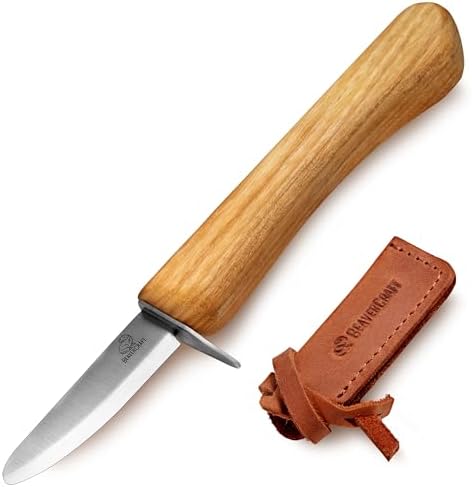
BeaverCraft C1 Kid Whittling Knife Review: Safety with a Real Steel Blade

The biggest problem with most “beginner” knives that are marketed towards children is that they can all be broken down into two terrible categories, which are either a dull piece of plastic that a child cannot use to cut wood, or a full-fledged knife that is far too sharp for a child’s small hands.

  • Safe and Reliable Whittling Knife for Kids: Our wood carving knife for kids is completely safe due to its thoughtful des…
  • Kids Whittling Knife with Ergonomic Design: The knife has a compact and convenient handle design that provides a secure …
  • Wood Carving Kids Knife Leather Sheath: A whittling knife for kids comes in a genuine leather blade sheath for maximum s…

The problem that the BeaverCraft C1 Kid Whittling Knife is trying to address is the middle ground. It is meant to be a real woodworking tool, with enough sharpness to be safe but with enough safeguards against common injuries. We discuss whether this product has the best balance of safety and performance for a beginner child.

It’s Sharp, and That’s Good

There is a common misperception that a blunter knife is a safer knife. The use of a blunt knife for whittling results in too much pressure being applied, which causes the knife to slip.

The blade is composed of High-Carbon Steel, which is not stainless. This contributes to it going extremely sharp with a long life span on that sharpness. It helps the child cut with ease, without applying force on the blade, as it progresses through the wood. The learning curve associated with this tool is technique-based, not tool-based.

The Mechanical Safety Features

BeaverCraft didn’t only reduce the size of an adult knife but changed the geometric angles for safety reasons.

The Rounded Tip: The most common problem beginners encounter is a puncture wound from a slipped tip. The C1 has a rounded, intentionally blunted nose tip. It’s not easy to poke someone with it, but with the straight edge, people still cut pretty effectively.

The Handle Size: The handle is made from Ashwood, which is a very robust wood. The size is also smaller compared to that of a typical carving knife. This is to make sure that a child, whose hands are small, is able to encircle the blade with his fingers in order to lock the blade in place as he is cutting, hence ensuring that it doesn’t turn.

Maintenance as a Teaching Minute

This is high-carbon steel, therefore it is not as resilient as a kitchen knife might be. It rusts when it is moist and dirty. This means that the user has to maintain the blade’s cleaning and stropping.

Although this might appear to be a negative, especially when it is compared to modern knives that can all be typically considered “disposable plastic cutlery,” it is a great way to instill discipline. The possession of such a blade instills how to respect professional blades, not that typically used for plastics.

Who Should Start Here?

If what you are looking for is a “toy” that your child can entertain him/herself with while unsupervised, that is NOT what you are looking for. This is a real blade that a child cannot use properly on his/her own.

In most cases, YES! But not if your aim is merely to teach the skill of wood carving with a tool that is forgiving of small mistakes (because of the rounded tip) but also emphasizes proper technique (because of the sharp steel), because in that regard, the best carpentry tool for a beginner is, at the moment, the BeaverCraft C1.

Best Beginner Knife Options: Safety Tools for Kids and First-Time Cooks

Cooking is a necessary life skill, but to trust a razor-sharp 8-inch chef’s knife in the hands of a 5-year-old, never mind a klutzy beginner, is asking for trouble. This is one case where the “standard” guidelines are irrelevant. You don’t need high-quality Japanese steel yet; what you need is safety, control, and forgiveness.

Whether it is teaching a child how to use motor skills or wanting a cost-effective way to equip a dorm kitchen, these products address the particular problem of injury potential as well as cross-contamination.

1. For “Toddler” Chef (Ages 4+): Nylon Safety Tools

The Problem: Edge sharpness vs. small fingers.

“If your aim is to make a young child a part of the process of preparing a meal, without your presence beside them, hyperventilating, metal blades are a no-no. You need a material that can slice a cucumber but not skin.”

  • Real Cooking Tools for Kids – Safe & Effective: Our kids knife set actually cuts fruits, veggies, cheese, and more—helpi…
  • Perfect Gift for Kids Ages 4+: A thoughtful present for birthdays, Christmas, or as a stocking stuffer. Lightweight, BPA…
  • Build Confidence & Healthy Habits: Kids are more likely to try new foods when they prepare them themselves. These knives…

The Recommendation: Tovla Jr. Kid Safe Knife Gift Set

Why It Works: They are made of BPA-Free material. They have a serrated blade that cuts soft fruits and vegetables efficiently but is blunted to the touch. This removes the possibility of deep cuts, giving kids a sense of empowerment to cut safely.

2. For “Pre-Teen” Apprentice (Ages 8-12): The Bridge to Real Steel

The Problem: Plastic knives cannot cut carrots, but regular knives are too large/heavy for kids.

The child, once he has outgrown the use of plastic, requires a genuine blade scaled to his size. An adult chef’s knife is cumbersome to handle with small hands.

  • MATCHING KNIVES TO FOOD -The kids chef knife set is ideal for cutting and chopping large food while the paring knife is …
  • KIDS FRIENDLY DESIGN – This kids kitchen knife set is designed to safely practice cutting food in the kitchen. Both kids…
  • TAKE CULINARY SKILLS TO THE NEXT LEVEL-Cooking is fun for kids, especially when getting to use kids’ knives to cut throu…

The Recommendation: Kibbidea Kids Knife Set (4-Pieces)

The Mechanics: This set brings in stainless steel but retains safety aspects such as rounded tips (to avoid accidental stabbing) and a finger guard. The wooden handles are reduced in size for a smaller grip circumference, which gives the child leverage on harder produce such as potatoes.

3. For the Budget Conscious Adult: Color-Coded Hygiene

The Problem: Cross-contamination and rust within communal kitchens.

In a dorm setting, such as a household, knives are commonly left damp, with tasks ranging from cutting chicken to slicing apples with insufficient washing.

  • 【15 Pieces Multipurpose Knife Set】 15 pieces knife set includes: 8″ Chef knife, 8″ Slicing knife, 7″ Santoku knife, 8″ S…
  • 【Black Non-Stick & Anti-Rust Coating】 The black coating on the stainless steel surface does a good job of stopping the k…
  • 【Amazing Built-in Knife Sharpener】 Kitchen knife sets with built-in sharpeners are very convenient and you can sharpen y…

The Recommendation: Astercook 12 Pcs Color-Coded Kitchen Knives Set

The Reasoning: This is not merely a matter of design. The color-coding system is a way to avoid cross-contamination (e.g. Red is for meats, Green is for vegetables). The rust-resistant finish is a safeguard against moisture, which is a highly necessary element in the event that a member of your household is guilty of leaving knives in the sink.

4. For High-Volume Prep: The Paring Solution

The Problem: Losing small knives quickly, losing edge quickly.

Paring knives are the most misused utensil in the kitchen. They are used to open packages, chucked in drawers, and misplaced. It is a waste of money for a beginner to buy high-quality ones.

  • 【Multi-functional Paring Knife Set】-The rainbow knife set can easily help you handle small or complex cooking tasks.For …
  • 【Pleeling Knife】- The peeling knife set is made of stainless steel and has been finely polished to become very sharp, ma…
  • 【Design Excellence】-Paring knife set adopts an ergonomic design concept aimed at achieving optimal comfort and control. …

The Recommendation: 8 pieces Paring Knives (with Sheaths)

WHY BULK IS BETTER: Having eight extremely sharp, cheap paring knives at your disposal always gives you a clean edge (no pun intended) when peeling or slicing small fruits. The presence of sheaths with the set is a vital consideration when storing the utensils in a drawer to keep from slicing your finger when stretching for a tool.

Bonus: Building Dexterity (Non-Kitchen)

The Problem: Learning blade control, patience.

At times, the best way to instill respect for a knife is not in the kitchen. Wood carving is a process that involves slow, precise cuts, which are very useful when handling a knife in the kitchen.

  • Safe and Reliable Whittling Knife for Kids: Our wood carving knife for kids is completely safe due to its thoughtful des…
  • Kids Whittling Knife with Ergonomic Design: The knife has a compact and convenient handle design that provides a secure …
  • Wood Carving Kids Knife Leather Sheath: A whittling knife for kids comes in a genuine leather blade sheath for maximum s…

The Recommendation: BeaverCraft Whittling Knife for Kids (C1 Kid)

The Application: Although this is a woodcarving tool, the rounded tip and ergonomic design teach outstanding hand-eye coordination skills. This is a fantastic “outside-the-kitchen” gift that instills the concentration skills necessary for expert knife usage later on down the line.

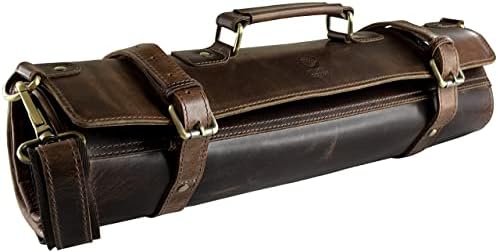
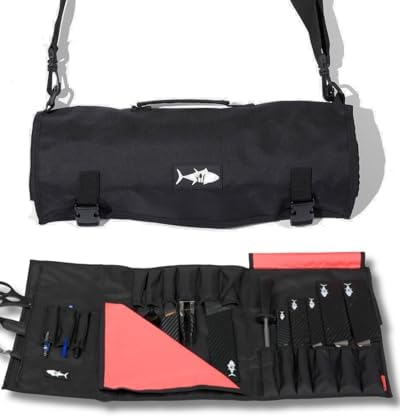
Best Knife Bags and Rolls for Home Cooks and Traveling Chefs

Loosely tossing a $150 chef’s knife into a tote bag or wrapping it in a kitchen towel is a recipe for two things: a ruined edge and a trip to the emergency room.

Whether you’re a professional commuting to a kitchen, a catering chef, or a home cook off to an Airbnb for the holidays, blade protection is absolutely non-negotiable. A proper knife carrier does more than just hold tools in place; it immobilizes the steel to prevent friction damage (dulling) and tip bending.

To choose the right vessel, you need to decide between two primary form factors a Roll versus a Backpack and two material classes: Leather versus Synthetic.

read more: Top 5 Most Popular Paring Knives

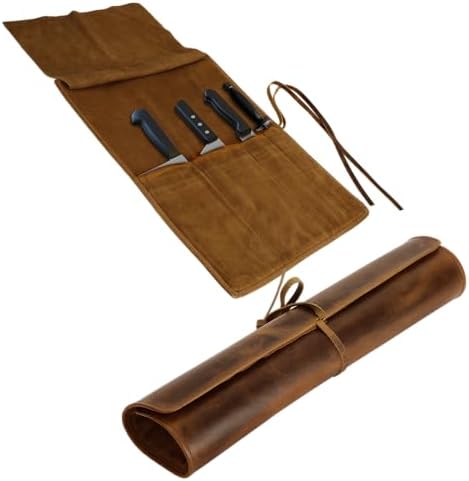
1. The Classic Knife Roll: Compact and Traditional

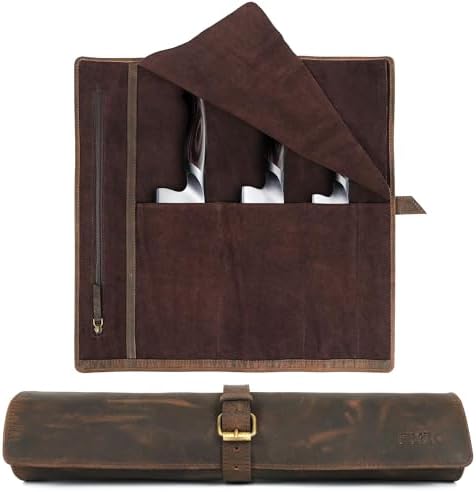
The knife roll is the industry standard for a reason. It’s designed to be unrolled on a counter, giving you immediate visual access to your entire kit.

  • Capacity: Typically holds 7-10 knives.
  • The Physics of Storage: Elastic retention slots and a zippered flap are key to a good roll. The flap is critical; it creates a barrier so that when the bag is rolled up, the handles of one knife don’t scratch the blades of another.
  • Best For: Line cooks and home chefs carrying a particular “Core Set” (Chef, Bread, Paring, Tweezers).

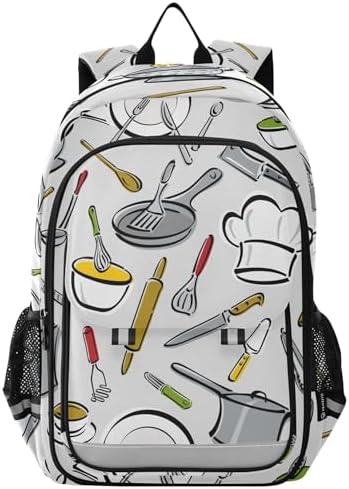
2. The Chef’s Backpack: For the Heavy Commuter

If you carry more than just steel laptops, honing rods, mandolines, and scales a roll becomes unwieldy. The Chef’s Backpack is the modern solution to weight distribution.

  • Ergonomics: Carrying 15 lbs of steel on one shoulder, messenger style, translates into eventual spine misalignment. A backpack spreads that weight across both shoulders.
  • Separation: Find a bag with a specifically strengthened “knife tech compartment” that’s separate from the laptop sleeve, to avoid punctures.
  • Best For: Culinary students and traveling chefs who bring their whole office with them.

3. Material Analysis: Leather vs. Ballistic Nylon

Leather The Heirloom Choice: Top-grain leather is tough, virtually puncture-proof. It will patina well over time, molding to the shape of your handles. But it does require upkeep conditioning and can be heavy.

  • Verdict: Buy this for style and longevity.

Waxed Canvas / Ballistic Nylon (The Utility Choice): These synthetics are lightweight, water-resistant and significantly cheaper. The high denier nylons are practically impossible to tear.

  • Verdict: Buy this for grueling, messy kitchen environments where the bag might sit in grease or water.

Verdict: What to Bring Along?

  • For the Purist: Get a Waxed Canvas Roll. It’s durable, light, and protects the essentials.
  • For the Student/Commuter: Get a Reinforced Backpack. Your back will thank you.
  • For the Head Chef: Get Top-Grain Leather. It demands respect and will last a lifetime.

Knife Set vs. Open Stock: Which is a Better Investment for the Home Kitchen?

The largest financial mistake when equipping a home kitchen has to be the “Wedding Registry” syndrome: purchasing a huge 15-piece knife block because it looks professional on the counter.

While aesthetically pleasing, these sets often represent a poor allocation of resources. You pay for 12 knives you rarely use to get the one Chef’s Knife you actually need. On the other hand, building a custom kit through buying piece-by-piece (“Open Stock”) requires some knowledge and patience.

To determine where to invest our money, we need to evaluate the two methods on the basis of Cost-Per-Use and Ergonomic Suitability.

1. The Case for Knife Sets: Volume and Value

A knife set is a collection bundled together and sold, often at a discount relative to the sum of its parts.

  • The Economics: If you do the math for price per blade, sets are cheaper. A generic 6-inch utility knife might be $60 open stock but is effectively $25 inside a block set.
  • The Target Audience: Sets are ideal for Empty Kitchens. If you are furnishing a first apartment or outfitting a vacation rental and have zero tools, a set gets you immediate functionality (Chef, Paring, Bread, Scissors, Honing Rod) in one purchase.
  • The Downside: You are stuck with the manufacturer’s handle geometry for every tool. If the Chef’s knife handle feels too bulky, you cannot swap it out without breaking up the set.

2. The Case for Open Stock: Performance and Customization

“Open Stock” refers to a purchase of individual knives. This strategy is consistent with the professional view: Invest in workhorses.

  • The 80/20 Rule: In truth, you do 90% of all kitchen work with only three knives: A Chef’s Knife (8″), a Paring Knife (3-4″), and a Serrated Bread Knife.
  • The Investment Strategy: You don’t buy a mediocre 15-piece set for $300; you buy a world-class Chef’s Knife for $150, a utilitarian bread knife for $30, and a paring knife for $10.
  • Ergonomic Freedom: Open stock allows mixing and matching. You can buy a heavy German Chef’s knife for chopping vegetables but a thin Japanese slicer for fish. You are not locked into one ecosystem.

3. The “Filler” Problem

There is primarily one technical argument against large sets: that they contain “Filler Knives.”

  • Redundant Blades: Most large blocks include a 6-inch Utility Knife, a 5-inch Santoku, and an 8-inch Chef’s Knife. Mechanically, these tools overlap significantly. An experienced cook will be able to do everything a utility knife can by using a Chef’s knife.
  • Serrated Utilities: A lot of sets contain little serrated “tomato knives” that, once they go dull, become almost impossible to sharpen and are essentially disposable, cluttering up the counter.

Related article: How to Safely Clean a Knife Handle: Wood, Synthetic and Composite Materials

Verdict: Which One Should You Get?

It’s going to depend on your current inventory and cooking style.

  • Get a Knife Set If: You’re starting from scratch, giving a wedding gift, or really like the look of a consistent block on the counter. It’s the path of least resistance.
  • Buy Open Stock If: You want maximum performance. By curating your own “Core Three” of Chef, Paring, Bread you get superior steel quality and ergonomics for the same total price.

The Complete Guide to Cleavers: Choosing the Right Weight for Meat and Bone

The most common catastrophe in home butchery is not cutting a finger; it’s destroying a $200 chef knife by striking a chicken bone.

Standard kitchen knives are designed for slicing, whereas cleavers are designed for chopping. But buying “a cleaver” is simply not good enough. The market is full of thin “Chinese Chef Knives” masquerading as bone choppers. Hit the wrong one against a beef rib, and it’ll chip instantly.

To choose the right tool, you need to understand three technical metrics: Spine Thickness, Mass, and Rockwell Hardness. We have grouped them by physics and usage below.

1. The Heavyweight: Western Bone Cleaver

For processing dense protein structures beef ribs, pork shoulders, or frozen meats you count on Momentum, not sharpness.

  • Physics: $Force = Mass \times Acceleration$. A lightweight cleaver requires you to swing your arm harder to cut through cartilage, which leads to loss of control. A heavy cleaver (1.5 lbs+) creates its own kinetic energy. You simply lift and let gravity drive the wedge through the bone.
  • Spine Thickness: Should be 4mm to 6mm. This will turn the spine into a splitting wedge, which protects the edge from rolling.
  • Steel Hardness: Ideally softer (54-56 HRC). Soft steel is tough; it will dent rather than shatter if hitting a femur.
  • Premium Durability And Quality – Super Sharp Cleaver Knife is made of high-quality stainless steel that resists rust, co…
  • Multi-purpose Cleaver’s Knife – Designed to be multipurpose knife for professional applications and it can be used for y…
  • Extremely Sharp Edge – Sharpness is key to achieving the best cuts and this is evident in the knife’s blade which is qui…

2. The Middleweight: Poultry and Lobster

Not every task requires a 2-pound beast. Whole chickens, duck, or lobster shell splitting requires a balance between agility and power.

  • Hybrid Role: These blades are often lighter (approx. 0.8 to 1 lb) with a thinner spine (2.5mm to 3.5mm).
  • Usage: It is sharp enough to slice through meat cleanly but has enough backbone to pop through joints and smaller rib cages. However, they should not be used on heavy beef bones.
  • Multi-purpose Cleaver: The classic 7″ Chinese kitchen knife easily handles your everyday kitchen needs such as chopping,…
  • Professionally Ground Sharp Blades: Hand sharpened by experienced artisans. The kitchen knife has an 18° angle on both s…
  • Extremely HC Outstanding Stainless Steel from Japan: This imarku Meat Cleaver is forged from excellent Japan imported hi…

3. The Lightweight: Chinese Vegetable Cleaver (Cai Dao)

This is the most misunderstood tool in the kitchen. Although it is rectangular like a cleaver, it is mechanically a Chef’s Knife.

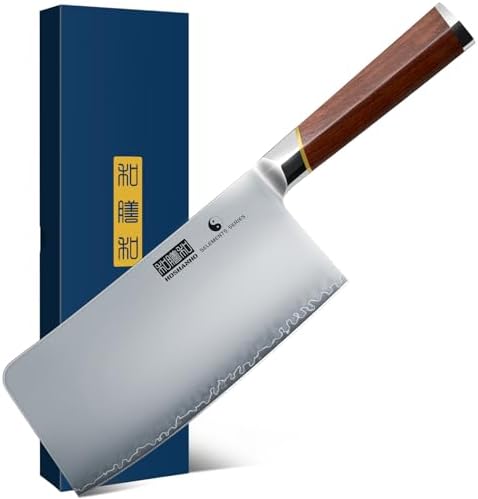
  • Blade Geometry: The spine is razor-thin (2mm or less). The edge angle is acute (often 15 degrees).
  • Usage: It is designed for push-cutting vegetables and slicing boneless meats. The broad blade is excellent for scooping up prep work from the cutting board.
  • Warning: Never strike a bone with this. The hard, thin steel will chip immediately.
  • 【Excellent Sharp Edge】The sharp blade with 15° on each side allows for clean and precise cutting, and the hardness is as…
  • 【Precision Forged Japanese Steel】This meat cutting knife is made of our specially formulated Japanese 10Cr15CoMoV stainl…
  • 【Ergonomic Handle Design】The handle of our chef’s knife is meticulously crafted for both comfort and control, designed f…

4. Critical Safety Feature: The Handle

Regardless of the weight class, the handle construction is nonnegotiable.

  • Full Tang: The metal of the blade must extend all the way through the handle. In a chopping tool, the stress on the neck (bolster area) is immense. Partial tangs will eventually snap, sending the blade flying.
  • Grip Material: When butchering, hands get covered in fat and moisture. Avoid smooth, polished handles. Look for textured composites (like G10 or Pakkawood) or textured polymers that provide traction when wet.

Verdict: Matching the Tool to the Tissue

  • Breaking Beef/Pork: Prioritize Mass (Weight). Get the heaviest tool you can safely lift.
  • General Prep: Prioritize Geometry (Thinness). A vegetable cleaver is the ultimate slicing machine, provided you respect its fragility.
  • Chicken/Game: Go for the Middleweight. Versatility is key.

Related article: Victorinox Fibrox Pro Boning Knife Review: Why It Is The Industry Standard

BYkooc Paring Knife Set Review: The $5 Workhorse?

In the world of kitchen tools, there is a whole category filled with things called “loss leaders.” These are things you purchase knowing they will get lost at a picnic, thrown away accidentally with pizza boxes, or “borrowed” by a roommate never to return. You do not need performance art; you need volume.

  • 【Multi-functional Paring Knife Set】-The rainbow knife set can easily help you handle small or complex cooking tasks.For …
  • 【Pleeling Knife】- The peeling knife set is made of stainless steel and has been finely polished to become very sharp, ma…
  • 【Design Excellence】-Paring knife set adopts an ergonomic design concept aimed at achieving optimal comfort and control. …

However, cheap often means dangerous dullness. The BYkooc 8-Pieces Paring Knife Set dominates the Amazon best-seller list not because it competes with Wusthof but because it solves the “disposable utility” problem better than any competitor.

Blade Physics: Thinness Over Hardness

With a knife that costs approximately $1.25 per unit, how can it actually cut anything? The secret of the blade geometry is in its thinness.

  • Stamped Construction: Unlike forged knives, which have a thick spine that tapers down, these blades are stamped from thin sheets of stainless steel.
  • The Physics: Because this blade is so thin almost razor-thin it generates very little friction passing through soft produce, like strawberries or cucumbers. It doesn’t split the food; it slides through it.
  • The Limitation: Do not use this on a butternut squash or sweet potato. This thin steel does not have the structural integrity for hard vegetables and will flex or snap under heavy lateral pressure.

Safety Mechanics: The Sheath Value

The main technical feature corresponding to this price class is the presence of independent sheaths.

Most budget knives are sold loose – creating a “drawer hazard” where you risk cutting your hand just reaching for a spoon. The snap-on sheaths allow these to be safely tossed into:

  • Gear for Camping: Without cutting through your bag.
  • Lunchboxes: To peel fruits at work.
  • Junk Drawers: Without dulling the edge against other metal objects.

Hygiene and Materials

These handles are made from molded Polypropylene (PP). Though they feel light almost “toy-like” to the touch, PP is chemically inert. It does not absorb water, odors, or bacteria, making these significantly more hygienic than cheap wooden handles which rot over time.

The Color-Coded System Black, Yellow, Green, and Red is not for mere aesthetics; this enables a simple form of HACCP cross-contamination prevention, such as Red for meat and Green for vegetables during food preparation.

The Realistic Verdict

If you’re a serious chef in search of balance and edge retention, look elsewhere. If you simply need a set of “beater” knives for an Airbnb, a dorm room, or for that trip you’re taking camping, the value proposition here is mathematically unbeatable.

The Good

  • Cost-Per-Use: At ~$5 for a set, the replacement cost is negligible.
  • Slicing Ability: Surprisingly sharp on soft fruits due to the thin blade profile.
  • Portability: Included sheaths make them the ultimate travel knife.

The Bad

  • Fragility: The thin stamped steel is brittle. It will snap or separate from the handle under heavy pressure.
  • Edge Retention: Soft stainless steel needs to be honed often to maintain sharpness.
  • Size: The handle is a bit small for big hands, standing at 3.8 inches.

HENCKELS Forged Accent 2-Pc Paring Set Review: Why Weight Matters

For most home cooks, a paring knife is considered a somewhat disposable item: They buy supercheap stamped sheet metal knives that feel like toys in the hand. And while they come sharp from the factory, they lack a critical physical property: Mass.

When peeling an apple or turning a mushroom “in-hand” (holding the food in the air, not on a board), this featherlight knife forces one to apply more grip pressure in order to control the blade leading to hand cramping. The HENCKELS Forged Accent Set solves this ergonomic failure by bringing a full bolster and forged construction to the budget category.

  • STAYS SHARP LONGER: Professional, satin-finished blade boasts precision cutting and is finely honed for long-lasting sha…
  • THE LAST KNIFE YOU’LL EVER NEED TO BUY: German Engineered Knife Informed by over 100 Years of Mastery. HENCKELS knives a…
  • DURABLE AND BALANCED: Forged bolster construction offers durability and balance and a seamless transition from blade to …

The “Forged” Difference: Bolster and Balance

The defining feature of this set is the Forged Bolster. This is the thick band of steel where the handle meets the blade.

This doesn’t exist in stamped knives, such as Victorinox or Vituer. In the Henckels Accent, this added mass shifts the center of gravity backward toward your fingers.

  • Why it matters: When the knife is balanced, the blade feels like a natural extension of your index finger. You get feedback from the cut without fighting the tip weight. It transforms a tedious task like peeling 5 pounds of potatoes into a controlled, rhythmic motion.

Two Sizes, Two Distinct Roles

Both have 3-inch and 4-inch blades. For a lot of novices, this might appear redundant, but their mechanics serve different distinct purposes:

  • 3-Inch (The Peeler): The shorter length brings the tip closer to your thumb. This minimizes leverage, giving you maximum control for intricate work like hulling strawberries or peeling garlic cloves.
  • 4-Inch (The Mini-Utility): This extra inch gives enough “runway” to use on a cutting board. It’s perfect for mincing shallots or slicing citrus, tasks where the 3-inch blade would be too short to complete a stroke.

Fit and Finish: German Engineering

While Henckels is the “value” brand compared to their premium Zwilling line, the DNA is the same. The blades are made from High-Quality German Stainless Steel.

The handles are made of ABS, with a classic triple-rivet design and a stainless steel endcap. This endcap is not simply cosmetic; it serves as a rear counterweight, further stabilizing the knife in your palm.

Should You Upgrade to Forged?

If you’re used to those dollar-store knives, picking these up is going to feel significantly heavier, and that’s the point. The weight does the work for you.

This set is for the home cook tired of having flimsy blades bend when cutting through a crisp apple. It offers 90% of the performance of a $100 Wusthof paring knife at a fraction of the price.

The Good

  • Balance: The forged bolster provides a professional, weighted feel rarely found at this price point.
  • Versatility: Having both 3-inch and 4-inch options covers every small prep task.
  • Durability: Triple-riveted handles and full-tang construction ensure the handle won’t snap off.

The Trade-off

  • Rust Potential: Although stainless, customer reviews report spotting if left wet. They have to be dried immediately.
  • Thicker Spine: Since they are forged, the blades are thicker than cheap stamped knives. To some users, they are a little bit wedgy on very dense vegetables such as carrots.

read more: Are Ceramic Knives Worth the Maintenance Hassle? (Sharpening & Durability Review)

Classic Meals

Best Healthy Oils for High-Heat Wok Cooking: Smoke Point Comparison

The secret to a successful stir-fry is not the heat alone; it is the oil you choose to handle that heat. Since woks operate...
- Advertisement -