Home Blog Page 13

GoodArtificer Titanium Cutting Board Review: Hygienic Marvel or Knife Killer?

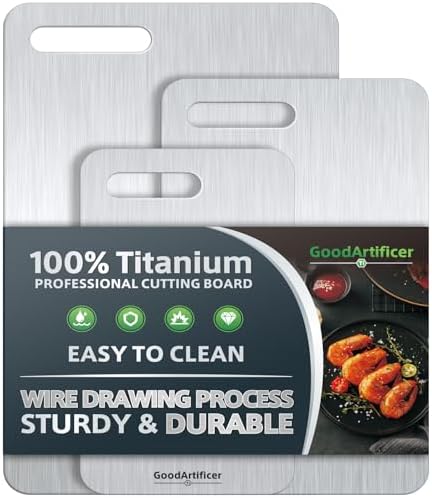
Home cooks are becoming increasingly aware of the hidden downsides of traditional prep surfaces. Plastic boards inevitably shed microplastics into our meals, while wooden boards can harbor deep-seated bacteria if they are not meticulously oiled and maintained. Enter a futuristic alternative that has rapidly climbed to the #1 Best Seller spot on Amazon with thousands of recent purchases: the GoodArtificer Titanium Cutting Board Set.

  • 【Titanium Cutting Board Set of 3】: Includes three cutting boards of different sizes: 16 inches long x 10 inches wide, 13…
  • 【Durable and Sturdy】: This cutting board is made of one-piece molded titanium alloy, without the use of any glue or adhe…
  • 【Health-Protecting Cutting Boards】: Compared to plastic, wooden, or bamboo cutting boards, our titanium cutting boards d…

While the concept of a solid metal chopping mat sounds like the ultimate solution to kitchen sanitation, does it actually make sense in a culinary environment? Here is our analytical breakdown of the physics and practicality behind this viral kitchen tool.

The Engineering: A Triumph of Kitchen Hygiene

From a pure sanitation and maintenance standpoint, this three-piece titanium set is an absolute masterpiece. Constructed from one-piece molded titanium alloy without the use of toxic glues or adhesives, these boards are entirely non-porous.

Unlike wood or bamboo, they will never absorb meat juices, warp from moisture, or retain the lingering odors of pungent ingredients like garlic and fish. You can process raw poultry, give the board a quick rinse, and slide its ultra-thin profile straight into the dishwasher without a second thought. For home cooks terrified of cross-contamination, the double-sided, rust-proof nature of pure titanium offers unparalleled peace of mind. Furthermore, the varying sizes (small, medium, and large) provide excellent versatility for different prep tasks without cluttering your countertops.

The Physics Problem: Steel vs. Titanium

However, our job as kitchen analysts is to look past the brilliant marketing and examine the physics of daily cooking. This brings us to the massive, undeniable trade-off of using any metal cutting board: rapid blade degradation.

Your kitchen knives are forged from steel. Titanium is a remarkably hard, unyielding metal. When you forcefully chop, dice, or rock your blade through ingredients, your steel edge is repeatedly striking a surface that offers zero shock absorption. While the titanium board itself will resist deep gouging, it will mercilessly roll, dull, or even micro-chip the finely honed edge of your chef’s knife.

A Specialized Tool, Not a Daily Driver

The GoodArtificer set is incredibly lightweight and a breeze to clean, which explains its glowing user reviews. Yet, we strongly advise against using it as your primary, everyday prep station.

Instead, view these titanium mats as specialized, tactical tools. They are the absolute perfect surface for breaking down highly messy, bacteria-prone raw meats provided you are using a cheaper, heavy-duty workhorse knife that you do not mind honing frequently. If you make sure to keep your expensive, delicate Japanese steel far away from its hard surface, this ultra-hygienic set is a brilliant, lifetime-lasting addition to your culinary arsenal.

Plateful Titanium Pan Review: The Truth About “Uncoated Non-Stick”

If you have been following our deep dives into the dangers of scratched Teflon and the fragility of ceramic Sol-Gel coatings, you know the ultimate kitchen holy grail is a pan that lasts forever, contains zero toxic chemicals, and prevents food from sticking.

  • PURE TITANIUM SURFACE: Crafted with SGS-certified titanium, this titanium frying pan delivers naturally smooth cooking s…
  • EXTREME HEAT RESILIENCE: Built to handle high-heat searing and oven use up to 750°F, this titanium hammered pan pro dist…
  • BUILT FOR LIFE: Unlike traditional nonstick, the titanium fry pan withstands metal utensils, repeated dishwashing, and d…

Enter the Plateful 12″ Pure Titanium Pan. While it has seen massive sales recently, it carries a bold marketing claim: a forever pan with a naturally non-stick surface that uses absolutely zero chemical coatings. However, a quick glance at its polarizing rating on Amazon reveals a disconnect between marketing promises and kitchen reality. Here is our analytical breakdown of why this pan is frustrating some while becoming a favorite for others.

The Engineering: Pure Titanium vs. Titanium-Infused

We must first commend what Plateful has actually built. Most “titanium” pans on the market are just standard aluminum pans sprayed with a PTFE (Teflon) coating that has microscopic titanium dust sprinkled into it.

The Plateful pan is completely different. It is constructed from 99.89% pure, SGS-certified titanium. Because there are no synthetic coatings (no PTFE, no Sol-Gel), this pan is virtually indestructible. It will never flake, peel, or off-gas toxic fumes. You can use metal utensils, throw it in the dishwasher, or blast it in a high-heat oven without a second thought. From a pure safety and longevity standpoint, it is a masterpiece of material science.

The Mastery of the Learning Curve

The primary reason for the mixed reviews lies in the company’s claim that the micro-textured titanium surface is “naturally non-stick.” Many buyers purchase this pan expecting it to perform exactly like a brand-new Teflon skillet. When they crack a cold egg into an unheated pan, it inevitably sticks.

The scientific reality is that uncoated bare metal is never truly non-stick in the way a polymer is. Like professional stainless steel, cooking on pure titanium requires a specific technique. You must pre-heat the pan thoroughly, add your cooking fat, and wait for it to shimmer before adding food. If you master this heat management, the food releases beautifully. If you treat it like a cheap non-stick pan, you will end up scrubbing.

A Long-Term Kitchen Investment

What makes this pan stand out is its resilience. It is immune to toxic off-gassing and chemical leaching, providing total peace of mind for health-conscious cooks. It is also incredibly lightweight compared to cast iron, making it much easier to handle during long cooking sessions.

The trade-off is clear: you are sacrificing the “out-of-the-box” ease of synthetic coatings for a tool that will never degrade and never need replacing. It is not a pan for the casual cook who wants zero effort; it is a tool for the chef who wants a permanent, non-toxic addition to their arsenal and is willing to learn how to use it.

GreenPan Valencia Pro Review: The Pioneer of Safe Ceramic Cookware

If you have read our deep dive on Is Ceramic Cookware Safe?, you already know that to escape the dangers of “forever chemicals” (PFAS) and PTFE, you need to look for Sol-Gel technology. When it comes to Sol-Gel, one brand stands above the rest as the original inventor of the technology: GreenPan.

  • SET INCLUDES: 8″ frying pan, 9.5″ frying pan, and 11″ frying pan
  • ATK AWARD-WINNING DESIGN: Valencia Pro recognized by America’s Test Kitchen and Good Housekeeping for exceptional perfor…
  • CUTTING-EDGE CERAMIC NONSTICK: Infused with diamonds, GreenPan’s metal utensil safe ceramic nonstick offers remarkable d…

If you are ready to completely eliminate toxic coatings from your stovetop, the GreenPan Valencia Pro 3-Piece Skillet Set is widely considered the gold standard. Priced around $160 for three versatile sizes (8″, 9.5″, and 11″), this set even holds a prestigious award from America’s Test Kitchen. Here is our analytical breakdown of why this specific collection outshines the competition.

The Engineering: Thermolon and Hard-Anodized Aluminum

Not all ceramic pans are created equal. Cheaper ceramic pans use a very thin layer of Sol-Gel over a flimsy aluminum body, resulting in a pan that warps and loses its non-stick properties in months.

The Valencia Pro series tackles this flaw with two distinct engineering upgrades:

  1. Diamond-Infused Thermolon: GreenPan’s proprietary Sol-Gel coating is infused with diamonds to increase its physical strength and heat conductivity. It is 100% free of PFAS, PFOA, lead, and cadmium. Even if you accidentally overheat the pan to 600°F in the oven, it will never release toxic fumes.
  2. Hard-Anodized Body with Magneto Base: The core of the pan is made from heavy-duty, hard-anodized aluminum, which is incredibly resistant to scratches and warping. Furthermore, GreenPan added their “Magneto” base, ensuring these pans work flawlessly on induction stovetops without losing heat efficiency.

Marketing Claims vs. Kitchen Reality

As analysts, it is our job to protect your investment. The GreenPan box proudly advertises that the Valencia Pro is both “dishwasher safe” and “metal utensil safe.”

While their diamond-infused coating is undoubtedly tougher than first-generation ceramic, the laws of physics still apply. As we explained in our guide on Why Is My Non-Stick Pan Sticking?, harsh dishwasher detergents and metal spatulas will inevitably create micro-abrasions in any Sol-Gel coating over time.

If you want this $160 investment to remain flawlessly slick for years, ignore the marketing hype: wash them by hand with a soft sponge, use only silicone or wooden utensils, and keep your burner on low to medium heat.

The Verdict: Is It Worth the Premium Price?

At roughly $160 for three pans, the GreenPan Valencia Pro set is a significant investment. However, considering you get three highly versatile sizes, an induction-ready anti-warp base, and the safest, most advanced PFAS-free coating on the market, the value is undeniable. It is the perfect compromise for health-conscious cooks who want the convenience of non-stick without the chemical anxiety of traditional Teflon.

Pros:

  • 100% free of PFAS, PFOA, lead, and cadmium.
  • Hard-anodized aluminum body prevents warping.
  • Magneto base ensures excellent induction compatibility.
  • Oven and broiler safe up to an impressive 600°F.
  • Awarded by America’s Test Kitchen for top performance.

Cons:

  • Premium price point.
  • Despite marketing claims, it still requires delicate hand washing to maintain longevity.
  • Sol-Gel coatings naturally degrade faster than traditional cast iron or stainless steel.

All-Clad HA1 Nonstick Skillet Set Review: The Ultimate Upgrade

If you are tired of throwing away cheap, warped frying pans every six months, you are not alone. When home cooks finally decide to invest in professional-grade equipment, they overwhelmingly turn to one specific brand. With over 3,000 sets bought in the past month alone and a phenomenal 4.5-star rating from over 15,000 reviews, the All-Clad HA1 Hard Anodized Nonstick 2-Piece Set is a dominant force in the premium cookware market.

  • This cookware set includes 8 inch and 10 inch Fry Pans, ideal for browning, searing, and pan-frying foods like eggs, veg…
  • High Quality Performance with Everyday Convenience – HA1 Nonstick heavy gauge aluminum and stainless-steel base deliver …
  • Design You Will Love- HA1 Nonstick has a sleek and stylish contoured design. Our double riveted stainless steel handles …

Priced around $100 for an 8-inch and 10-inch combo, it is a serious kitchen investment. Here is our analytical breakdown of why this set solves the classic sticky-pan problem.

The Engineering: Hard Anodized Durability

In our deep dive on Is Teflon Bad For You?, we established that modern PTFE is perfectly safe provided it is PFOA-free and not overheated. All-Clad takes this chemistry seriously, engineering the HA1 interior with three distinct layers of high-performing, PFOA-free PTFE non-stick coating.

However, the real magic is what lies beneath the coating. Unlike flimsy grocery-store pans, the HA1 is constructed from heavy-gauge, hard-anodized aluminum. It is capped with an anti-warp stainless steel base, making it fully compatible with induction cooktops. This thick construction prevents the pan from warping under thermal shock, ensuring your oil spreads evenly across a perfectly flat surface.

Performance and User Insights

Because of the heavy-gauge aluminum, these pans possess a substantial, professional weight. They do not feel like cheap aluminum toys.

This weight leads to incredible heat retention, which brings us to a crucial operational rule. As one highly-rated verified buyer astutely pointed out in their review, the secret to making this All-Clad set last for years is temperature control. Because the heat distribution is so efficient, you only need low to medium-low heat to cook eggs or sear meats perfectly. Blasting this pan on high heat is completely unnecessary and will only degrade the non-stick surface over time.

A quick user tip: The heavy, double-riveted stainless steel handles provide a secure grip, but they can be heavy for users with arthritis. Purchasing a cheap silicone handle slide-on cover is a popular and effective hack among daily users.

The Verdict: Is It Worth the Price?

While All-Clad advertises these pans as dishwasher safe, we strongly recommend against it. The harsh detergents will eventually eat away at the three-layer coating. Hand-wash them with a soft sponge, and use a product like Bar Keepers Friend on the stainless steel bottom to keep them looking brand new.

If you respect the coating, use silicone or wooden utensils, and keep your stove on medium heat, the All-Clad HA1 set will provide years of flawless, slide-off-the-pan performance.

Pros:

  • Professional-grade, hard-anodized heavy-gauge aluminum prevents warping.
  • Features 3 layers of premium, PFOA-free PTFE non-stick coating.
  • Stainless steel base makes it 100% induction compatible.
  • Oven and broiler safe up to 500°F.
  • Incredible track record with over 3,000 monthly sales.

Cons:

  • Noticeably heavier than standard aluminum pans.
  • Premium price point ($100 for two pans).
  • Stainless steel handle design can be uncomfortable for some users.

Why Is My Non-Stick Pan Sticking? (And How to Fix It)

It is one of the most frustrating things you can experience in the kitchen. You purchase a brand new, flawlessly slick non-stick skillet. Your morning eggs cook in the pan as if they are sliding across the ice. However, after six months, the magic is gone. Your food is now sticking to the pan, tearing apart, and leaving behind a burnt, sticky mess.

  • This cookware set includes 8 inch and 10 inch Fry Pans, ideal for browning, searing, and pan-frying foods like eggs, veg…
  • High Quality Performance with Everyday Convenience – HA1 Nonstick heavy gauge aluminum and stainless-steel base deliver …
  • Design You Will Love- HA1 Nonstick has a sleek and stylish contoured design. Our double riveted stainless steel handles …

Are you looking at your ruined breakfast, wondering, “why is my non stick pan sticking?” You are not alone. However, to fix the problem, we first need to discuss the science behind the stick.

The Science of the Stick: 3 Reasons Your Non-Stick Pan is Sticking

Are you using an old PTFE (Teflon) pan or a newer, more advanced Sol-Gel (ceramic) pan? Regardless, the non-stick coating is based on microscopic chemical bonds. If the microscopic bonds are blocked or broken, the pan becomes sticky. The following are the three main reasons why your non-stick pan is now sticking:

1. Carbonization from Cooking Spray

This is the most common reason why your non-stick pan is now sticking. The problem is caused by the emulsifiers found in most aerosol cooking sprays. The emulsifiers, usually soy lecithin, are designed to mix two liquids that would normally not mix, such as oil and vinegar. However, the emulsifier itself does not evaporate as easily as the oil. Instead, the emulsifier bakes into the microscopic pores of your pan at relatively low temperatures, creating an invisible, sticky mess on the non-stick coating.

2. High Heat Degradation

A non-stick pan is designed to cook food using low to medium heat. However, are you the type of cook who likes to blast the pan with high heat to sear the steak? If you are, the high heat is breaking the microscopic chemical bonds in the non-stick coating, causing the pan to become sticky.

3. Micro-Scratches

Spatulas, forks, and abrasive scrubbing pads scrape away microscopic areas of the non-stick finish, allowing food proteins to bind to them during cooking.

How to Fix a Sticky Non-Stick Pan

If your non-stick pan has a buildup of old oil residue and emulsifiers, its non-stick surface may still be in relatively good condition. You can rid your pan of this tough grime using a powerful, deep-cleaning process:

  1. Put water in your sticky pan, leaving one inch of headroom at the top.
  2. Add one half cup of white vinegar and bring to a gentle boil on your stovetop.
  3. Remove from heat and immediately add two tablespoons of baking soda, which will fizz rapidly.
  4. Let your mixture sit and cool for 15 minutes.
  5. Throw away your mixture and use a non-abrasive sponge to scrub your pan clean.

The combination of acid and alkaline chemistry will dissolve your invisible layer of baked-on grime, restoring your pan to its original non-stick finish.

The Hard Truth: When It Is Time to Say Goodbye

While the vinegar and baking soda trick can revive a dirty pan, physics has a way of getting in the way when we want to pretend our pans are still alive and functional.

You’ve scrubbed your pan, and it still sticks? You’ve looked inside your pan and seen your underlying metal surface shining through? Your non-stick pan has died, and there is nothing you can do to revive it. The non-stick surface has been destroyed, and no amount of cleaning, seasoning, or Internet trickery can regrow a synthetic chemical surface.

Once the coating has been stripped, it is time to discard the pan. To prevent this from happening in the first place, consider moving to a highly durable hard anodized skillet, or take the plunge and move to a material like carbon steel, which develops its own non-stick surface naturally over time.

Is Teflon Bad For You? PTFE & Scratched Pans Explained

For years, the non-stick frying pan was the epitome of convenience for the modern cook. The ability to slide a fragile omelet directly onto a plate without a crusted mess was nothing short of magical. But this magic was recently replaced with alarmist headlines, documentaries, and social media posts and warnings. Millions of cooks are now standing in front of their older skillets, asking, “Is Teflon bad for you?”

  • This cookware set includes 8 inch and 10 inch Fry Pans, ideal for browning, searing, and pan-frying foods like eggs, veg…
  • High Quality Performance with Everyday Convenience – HA1 Nonstick heavy gauge aluminum and stainless-steel base deliver …
  • Design You Will Love- HA1 Nonstick has a sleek and stylish contoured design. Our double riveted stainless steel handles …

To cut through the hysteria and get to the facts, we need to examine the alphabet soup of chemicals known as PTFE, PFOA, and PFAS, and then examine the actual chemistry and biology to determine if these chemicals are actually dangerous to humans.

The Chemistry of Teflon: What is PTFE?

First, we need to determine just what Teflon is and if it is actually dangerous to humans. “Teflon,” as a word, is actually a brand name, and that brand name was originally owned and still is owned by the Chemours Company, a spin-off of DuPont. The actual name for the non-stick material is a synthetic material known as polytetrafluoroethylene, or PTFE.

The actual composition is a synthetic material known as a fluoropolymer, a type of plastic that is extremely slippery and extremely stable. PTFE is entirely inert at room temperature and at all commonly used cooking temperatures. It does not react with any known substance, including your food, water, or even chemicals. It is, therefore, entirely safe to cook on, if we are talking about actual PTFE and its composition and behavior.

The Ghost of the Past: The PFOA Problem

If PTFE is safe, then why are people worried about cancer and Teflon use? The problem is that PTFE is not actually used to make non-stick cookware; rather, a different compound known as PFOA is used.

Historically, PFOA was part of the manufacturing process, as it was necessary to bond the PTFE coating to the metal pan. PFOA is considered a “forever chemical” and is part of the PFAS family. PFOA is associated with a number of health issues, including thyroid problems, chronic kidney disease, and cancer. PFOA is also notorious for its permanent presence in the environment and the human body.

The reality check is as follows: PFOA is now banned. In the United States and Europe, the use of PFOA in the manufacturing process for non-stick cookware was completely eliminated by 2013. If you purchase a new non-stick pan, it does not have PFOA. However, if you are still using an old, scratched-up, hand-me-down Teflon pan from 2005, it is time to toss the pan in the dumpster.

The Real Danger: Temperature and “Teflon Flu”

While the modern non-stick pans are PFOA-free, they are not indestructible. The primary danger associated with modern PTFE non-stick pans is temperature control.

PTFE is only heat-stable up to a certain temperature. If you put an empty non-stick pan on the burner and crank the heat, the metal part of the pan can easily reach 500 degrees Fahrenheit (260 degrees Celsius) or hotter. At this extreme temperature, the PTFE coating literally begins to break down and release noxious chemical fumes.

Inhaling these invisible, odorless, and tasteless chemical fumes causes the well-known medical condition called Polymer Fume Fever, or “Teflon Flu.” The symptoms are the same as having a viral infection, complete with chills, headaches, fever, and flu-like body aches. While only temporary in nature, “Teflon Flu” is famously deadly to pet birds in the house.

Is Scratched Teflon Toxic?

This is the most common situation in any home kitchen. You are using a metal spatula, and suddenly your non-stick pan has silver lines scratched into it. This brings us to the ultimate question: is scratched Teflon non-toxic if you accidentally eat the Teflon chips?

To our surprise, the answer is no. PTFE is chemically inert, meaning that even if you accidentally eat a microscopic piece of Teflon non-stick coating, your body will be unable to assimilate it. Instead, it will pass completely through your stomach without any adverse effects.

But even with this knowledge, it is recommended that you replace the scratched non-stick pan immediately. Although Teflon non-stick chips are non-toxic, they also mean that the scratched pan is no longer non-stick. This means that when cooking, the food will burn and stick to the pan. You will have to use high heat to cook the food properly. Also, the aluminum will leach into the food when cooking acidic ingredients like tomatoes. This will give your meal a metallic taste.

The Final Verdict on Non-Stick Safety

So, is Teflon non-stick bad for you? If you are using a non-stick pan with PTFE non-stick coating and are using low-to-medium heat on your stove, then Teflon non-stick is safe to use.

However, the margin for error is small. All it takes is to forget an empty non-stick pan on high heat to fill your kitchen with noxious fumes. PTFE non-stick is also very fragile. You will inevitably scratch the non-stick surface of the pan. This will mean that you have to buy a new non-stick pan every few years. This is very bad for the environment.

If you are fed up with worrying about invisible fumes, Teflon non-stick peeling, and having to buy non-stick pans regularly, it is time to explore other non-stick pan options.

Classic Meals

Do All Coffees Bloom the Same? How Bean Origin, Roast, and...

You may already know that coffee percolates differently sometimes. Some froth like a good science experiment, while others barely puff. That's not an accident...
- Advertisement -