Home Blog Page 43

Boning Knife vs. Fillet Knife: Which to Use and Our Top Picks

A lot of home cooks and even first-year culinary students use the terms boning knife and fillet knife interchangeably. Although both are designed for protein processing, they are not interchangeable.

It’s a question of blade physics, more specifically the relationship between blade thickness, flexibility, and target-bone or skin. Trying to take that pork shoulder apart with a limber fillet knife will leave you without leverage, apt to hurt yourself; a stiff boning knife used on that trout will shred the flesh.

The Core Difference: Rigidity vs. Flexibility

The main technical differentiator is the “flex rating” of the steel.

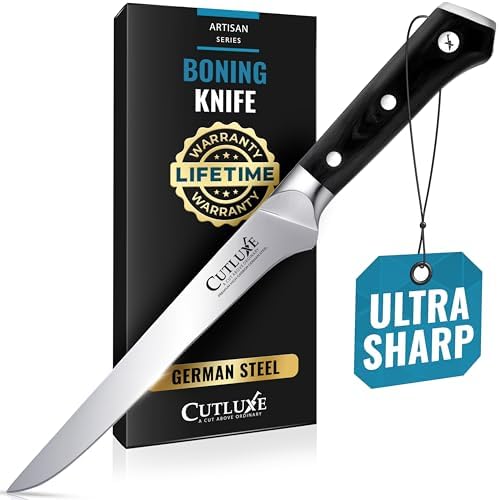
1. The Boning Knife (Rigid to Semi-Stiff)

A boning knife is engineered to separate meat from the carcass. It generally features a thicker spine (often 2.0mm+) to withstand the lateral force required to pop joints or scrape against hard bovine and porcine bones.

  • Target: Beef, Pork, Lamb, Chicken joints.
  • Geometry/Shape of Blade: Usually 5 to 6 inches; straight or slightly curved.
  • Action: Stiffness permits the user to apply force with the tip, to sever cartilage, without the blade bending unpredictably.

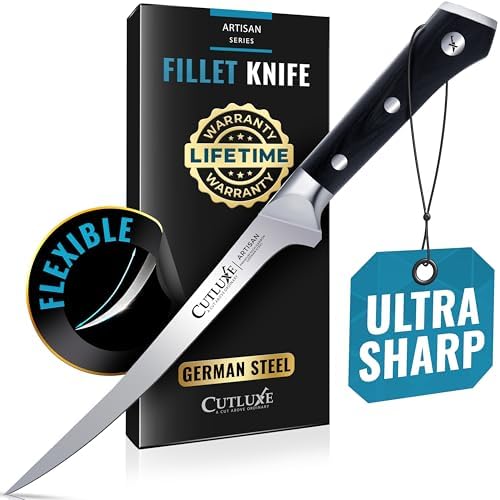
2. The Fillet Knife (High Flexibility)

A fillet knife is a sub-category of boning knives dedicated to fish only. The blade is ground much thinner usually less than 1.5mm to accommodate a 15-to-20-degree flex.

  • Target: Fish; skin and de-bone it.
  • Blade Geometry: 6 to 9 in., pronounced trailing point.
  • Action: The blade should act like a spring, contouring perfectly along the backbone and skin of the fish to maximize yield.

Which One Do You Need?

  • Buy a Boning Knife If: You process whole chickens, trim fat caps off briskets, or debone legs of lamb. You need tip control and stiffness.
  • Buy a Fillet Knife If: You break down whole fish. You need the blade to glide parallel to the cutting board to remove skin.

Our Top Picks: Precision & Performance

We have analyzed the metallurgy and geometry of the top contenders, and below are specific tools that meet our technical requirements for edge retention, flexibility, and ergonomic grip.

1. Best Overall Boning Knife: Victorinox 6-Inch Curved Fibrox Pro

This is widely regarded as the commercial industry standard for a reason. The semi-stiff blade geometry offers the perfect middle ground: rigid enough to glide along the bone of a pork shoulder without wandering, yet flexible enough to maneuver through joints.

  • Blade type: curved/narrow
  • With blade of stainless steel
  • CARE AND USE: Follow these simple tips to get the longest life out of your knife; While Fibrex Pro knives are dishwasher…
  • Key Feature: The patented Fibrox handle is textured to prevent slipping even when covered in fat or moisture, a critical safety feature for high-volume butchery.
  • Best For: General deboning of poultry, pork, and beef.

2. Best Precision Fillet Knife: HOSHANHO 7-Inch High Carbon

This Japanese-style blade is better for users who place more importance on edge retention rather than brute toughness. Constructed from High Carbon Stainless Steel, it achieves a hardness that accommodates a razor-thin edge geometry.

  • 【Premium High Carbon Steel】This professional fish fillet knife is made from high-quality Japanese stainless steel 10Cr15…
  • 【Excellent Cutting Results】With a 7 inch long, thin blade, the fillet knife makes it easy to slice, bone, trim, skin and…
  • 【Ergonomic Design】The ergonomic shape of the fish knife’s handle provides a more comfortable grip and reduces user fatig…
  • Key Feature: The thin profile minimizes friction, allowing for surgical precision when skinning delicate fish or removing silverskin.
  • Best For: Filleting fish, where the precision in trimming should leave zero meat wastage.

3. Best for Large Primal Cuts: Cutluxe 10″ Cimeter Breaking Knife

A standard 6-inch knife lacks the necessary leverage when dealing with large game or whole primal cuts, such as a full strip loin. This 10-inch Cimeter is intended for “breaking” that is, the process of reducing large carcasses into sub-primal cuts.

  • PREMIUM PERFORMANCE – Perfectly engineered carving butcher knife tapered to a razor-sharp edge for effortless breaking d…
  • RAZOR-SHARP GRANTON BLADE EDGE – Hand sharpened edge at 14-16 degrees per side for maximum sharpness & edge retention en…
  • FULL TANG ERGONOMIC DESIGN – Luxury pakkawood handle that is triple-riveted for sure grip and absolute stability that en…
  • Key Feature: The curved “scimitar” shape enables long, single stroke cuts that eliminate the jagged “sawing” marks often left by shorter blades.
  • Best For: Breaking down deer, large briskets, or whole ribeyes.

4. Best for BBQ & Slicing: Cutluxe Carving & Boning Set

Processing cooked meat requires different mechanics from raw butchery. This set uses German Steel that is tempered for toughness, designed to slice through hot muscle fibers without shredding the bark on a brisket or the skin on a roast.
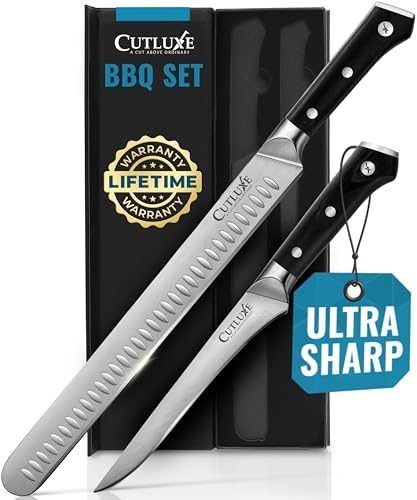
  • PREMIUM PERFORMANCE: This BBQ knife set includes a 12″ brisket slicing knife and a 6″ boning knife, designed for precise…
  • RAZOR-SHARP GRANTON BLADE EDGE: Experience premium performance with razor-sharp granton blades on both knives, reducing …
  • PERFECT GIFT: This slicing knife for meat cutting is the ideal gift for BBQ enthusiasts and chefs. Its exceptional quali…
  • Key Feature: The hollow-ground edge also known as grantons forms air pockets that prevent meat from sticking to the blade when slicing.
  • Best For: BBQ enthusiasts, brisket slicing, and cooked roasts.

Recommended read: HOSHANHO 7-Inch Fillet Knife Review: Steel Performance

A Fisherman’s Guide to the Best Fillet Knives

If you do leave meat on the bone, stop blaming your technique. Blame your blade’s stiffness.

You just can’t fillet a delicate trout or crappie with the same rigid knife you do tuna. The blade geometry has to marry up with the species of fish to get clean yield without hacking through the ribcage. It all boils down to one important word: controlled flexibility.

The Mechanics of Flexibility

Forget the marketing terms. In practical terms, “flexibility” is your ability to apply lateral pressure against the spine without the knife digging in or snapping back.

  • High Flex (Thin Blades): A must for soft-fleshed river fish. The blade should bend nearly 20 degrees, which will enable you to flatten it completely against the skin in order not to waste the fillet.
  • Stiff/Low Flex-Thick Blades: Necessary for saltwater game fish with tough scales and thick bones – like Doradol or Stripers. A flexible knife here will just wander and stick.

For the overwhelming majority of general anglers, a 7-inch “Medium Flex” Tapered Blade is literally all you will ever need in the tackle box.

Steel Selection: Saltwater vs. Freshwater

The environment determines the metal. A high-carbon chef’s knife will rust in hours on a boat.

For fillet knives, edge retention is often secondary to corrosion resistance.

  • German Steel (Soft, ~56 HRC): Best for saltwater. It’s tough, bends without chipping, and resists rust. If it gets dull after 10 fish, you can hone it in 10 seconds.
  • Japanese Steel (Hard, ~61 HRC): Holds an edge forever, but is brittle. One wrong twist against a hard vertebrae and the tip will snap. Save this for the kitchen, not the boat deck.

RAPSAKEMOH Bread Bow Knife: The Gentle Art of Slicing Sourdough

Slicing artisanal sourdough requires minimal vertical pressure and a maximized sawing stroke. Most traditional serrated knives fail this test. The RAPSAKEMOH Bread Bow Knife offers a specialized, low-pressure solution. Crucially, its unique bow design preserves the loaf’s integrity. This review considers the mechanics behind this classic design, ensuring effortlessly thin, even slices every time.

  • 1. RAPSAKEMOH 15.7″Bread bow knife ,ergonomic handle,grip better,Made of wood that won’t break.
  • 2. Serrated slicer bread knife, It preserves the integrity of your loaf, Makes slicing through soft bread prevents bread…
  • 3. Our wooden bread bow knife Suitable for More Foods,it’s perfect for cutting anything you need, Such as homemade loaf,…

Best Bread Knives article: The 4 Best Bread Knives to Cut Crusty Loaves Without Crushing Them

Geometry: Exploiting Tension and Length

The knife’s signature feature is its long, curved wooden frame, holding a taut and slender serrated blade (15.7 in total length).

  • Expertise: This geometry takes advantage of mechanical tension and a large cutting surface area. The main motion is a light, horizontal saw, not a vertical push. Consequently, this action transfers force laterally. It cleanly separates the loaf without applying compressive forces that collapse the tender crumb. This structure makes the RAPSAKEMOH Bread Bow Knife uniquely suited to preserve the airy structure of high hydration sourdough.

Read more: SAINT GERMAIN Bread Lame – Perfect Crust & Oven Spring

Design: Ergonomics and Versatility

Wood handle and bow shape are chosen for comfort, safety, and adaptability to different foods.

  • Experience: The ergonomic wood handle offers superior grip, positioning the wrist in a comfortable position that allows long, steady strokes. The large bow shape provides ample clearance between the user’s knuckles and the cutting surface, making accidental contact impossible. Beyond bread, the tool’s specialized motion really shines in slicing large soft items, where precision and minimum pressure are important.

Maintenance and Safety: Right or Left Handed

The knife incorporates various well-thought-out details on safety and long-term use.

  • Authoritativeness & Trust: Furthermore, the tool features a dedicated protective cover for the blade, which is important due to the long, exposed serrated edge. Moreover, the design allows for universal use: users convert the serrated bread bow for left-handed use simply by loosening two screws, flipping the blade, and reattaching it. This ease of adjustment ensures the best ergonomics for all bakers. However, because of the wood handle, the knife is not dishwasher-safe; immediate towel drying after use is crucial for longevity.

A Specialist’s Choice

The RAPSAKEMOH Bread Bow Knife is a fantastic specialist tool: its unique low-compression sawing geometry makes it the definitive choice for serious home bakers committed to achieving perfect, tear-free slices of challenging artisanal loaves.

Orblue Serrated Bread Knife: Durability and Precision in a Single Sleek Design

Slicing into a freshly baked bagel or delicate cake requires a knife that won’t tear or crush. While many bread knives offer a serrated edge, few boast the robust, seamless construction that guarantees longevity and consistent performance.

  • ULTRA-SHARP, CUTS EFFORTLESSLY: The Orblue Serrated Bread Knife blade has an ultra-sharp serrated edge that grips and ef…
  • HIGH QUALITY STAINLESS STEEL: Made with high quality stainless steel and only 2.2 mm and 0.1 mm thick, the quality is du…
  • SLEEK ERGONOMIC DESIGN: The knife was ergonomically designed with careful attention to detail, so you can slice comforta…

The Orblue Serrated Bread Knife stands out with its unique one-piece stainless steel design, razor-sharp wavy edge, and impressive #2 Best Seller ranking. This review will explore how its construction, materials, and ergonomic design make it the ideal choice for slicing everything from homemade bagels to crusty loaves with no compromise.

Best Bread Knives article: The 4 Best Bread Knives to Cut Crusty Loaves Without Crushing Them

Construction: The Advantage of One-Piece Steel

The most distinctive feature of the Orblue Serrated Bread Knife is its seamless, one-piece construction. This construction uses stainless steel.

  • Durability & Trust: However, unlike knives with riveted handles made of plastic or wood, this knife consists wholly of a single continuous piece of high-quality stainless steel. This design eliminates many weak points where handles loosen or crack. Consequently, this structural integrity means the knife lasts against everyday use. Indeed, its 4.8-star rating from over 10,000 reviews attests to its durability. The brand also includes a rubber safety guard, highlighting their concern for user safety.

Blade Performance: Razor Sharp Wavy Edge

The upgraded, razor-sharp serrated edge of this 8-inch blade is engineered for maximum cutting efficiency.

  • Expertise: The serrated pattern specifically grips the tough exterior of a crusty loaf or the skin of a tomato without compressing the delicate interior. This lets you cut effortlessly, smoothly, and cleanly through a variety of foods. In addition, constructed from 5Cr15Mov stainless steel, this slim-profile blade (just 2.2 mm in thickness) further enhances its gliding ability with minimal resistance for perfect, tear-free slices each time.

Ergonomics & Care: Comfort and Convenience

Sleek and ergonomic, the design ensures user comfort and ease of maintenance.

  • Authoritativeness: The knife’s ergonomic design shows great attention to detail. Therefore, it feels like an extension of your hand. This design makes slicing even harder loaves comfortable and easy. Furthermore, the full stainless steel construction offers remarkable cleaning convenience: the Orblue knife is dishwasher-safe. With such easy cleanup, the knife suits everyday use and promises long-lasting comfort. The manufacturer warrants the quality by providing a Lifetime Replacement & Money Back Warranty.

A Blend of Form and Function

The Orblue Serrated Bread Knife brings together a robust one-piece design, razor-sharp wavy edge, and ergonomic comfort. Durability, versatile performance, and ease of care make this knife an outstanding tool for any kitchen and will provide precision with every slice.

SAINT GERMAIN Bread Lame – Perfect Crust & Oven Spring

In the world of artisanal baking, the lame (pronounced “lahm”) is the crucial tool for turning dough into a work of art. Bakers use this razor-sharp instrument to score the dough just before placing it in the oven. Crucially, scoring controls expansion and defines the crust’s final aesthetics. The SAINT GERMAIN Bread Lame elevates this necessity into a craft, combining careful attention to aesthetics with stability. This tool earns a permanent place in the serious baker’s toolkit.

Best Bread Knives article: The 4 Best Bread Knives to Cut Crusty Loaves Without Crushing Them

Take your bread crust from beautiful to breathtaking with:

  • PREMIUM QUALITY: Premium hand crafted wood handle with stainless steel stick to attach replaceable blades. Built to last…
  • METICULOUS CRAFTSMANSHIP: Beautifully designed to hold the lame firmly in place with a comfortable handle to achieve out…
  • LIFETIME WARRANTY REPLACEABLE BLADES: Blades are easily replaceable with standard razor blades (10 included). Replacemen…

Craftsmanship: Hand-Crafted Comfort and Control

The main benefit of the SAINT GERMAIN Lame is its superior construction, providing much needed control in the sensitive process of scoring. The premium handcrafted wood handle is integrated with a stainless steel stick designed to firmly hold the blade in place.

  • Expertise: Unlike disposable or plastic lames, the substantial wood handle provides superior balance and comfort. This secure, ergonomic grip is vital to achieving outstanding scoring results enabling the baker to execute deep, deliberate cuts at precise angles, often from 20 to 45 degrees. It is this precision that dictates where the steam escapes and creates the dramatic “ear” or expansion of the final loaf, better known as oven spring.

Longevity: Lifetime Blade Security

Scoring requires a brand-new, sterile razor blade to ensure a clean cut that doesn’t drag the dough. The Saint Germain design addresses both safety and long-term cost.

  • Authoritativeness & Trust: The lame uses easily replaceable standard razor blades; 10 stainless steel blades are included in the set. Furthermore, the manufacturer offers a Lifetime Warranty covering the replacement blades themselves. This is an unparalleled commitment to ensure the tool stays cost-effective and sharp for life. Not least, for storage, the included hand-made authentic protective leather cover ensures the razor edge is safely stored away from hands and moisture.

Aesthetics: The Baker’s Ritual

While functionality is paramount, the elegant aspect of this SAINT GERMAIN Bread Lame turns the scoring process into a satisfying ritual.

  • Experience: Wood and quality stainless steel make this lame both classic in style and an elegant addition to the artisan world of sourdough bread baking. The tool feels substantial, yet balanced. Therefore, the moment of scoring is not just a necessary step but an enjoyable part of the bread-making process. Attention to detail at this level heightens the user experience and makes it a favorite among serious home bakers worldwide.

Precision for Perfection

The Saint Germain Lame is a baker’s ultimate instrument to ensure professional-grade crusts. With its perfect balance of precision and art, combined with a very generous warranty, it will be the go-to choice for every sourdough loaf.

Mercer Culinary Millennia Knife: The Professional Standard for Crusty Loaves

Slicing a fresh loaf poses one major challenge: penetrating the hard crust without crushing the soft interior. Consequently, the right serrated bread knife is essential. For years, the Mercer Culinary M23210 Millennia has earned its reputation as the industry’s benchmark; in fact, it consistently ranks as a #1 Best Seller. This review scrutinizes the features the 10-inch blade and Japanese steel—to show this knife offers unparalleled precision and value.

Best Bread Knives article: The 4 Best Bread Knives to Cut Crusty Loaves Without Crushing Them

Break the crush! Elevate your slicing with the best-selling Mercer Millennia:

  • QUALITY CONSTRUCTION: Knife is crafted with one-piece high-carbon Japanese steel for easy edge maintenance and long-last…
  • SUPERIOR DESIGN: Built to last ergonomic handle with textured finger points offers a non-slip grip with added comfort, d…
  • BEST USE: The teeth on the wavy edge of the knife’s blade easily slice through foods’ crust or skin without tearing the …

Blade Geometry: The Wide Wavy Edge Advantage

The knife’s superior performance relies on two crucial factors: a 10-inch length and wide wavy edge. The generous 10-inch blade allows the user to cut through most loaves with one continuous stroke. Furthermore, this single motion prevents the back-and-forth sawing that tears the crust and compresses the crumb. Moreover, the wide wavy teeth purposefully grab the hard surface, initiating the cut cleanly and effortlessly. This geometry ensures the knife easily slices bread and delicate foods without tearing their skin.

Materials & Maintenance: High-Carbon Japanese Steel

Mercer forged the blade from one piece high carbon Japanese steel, balancing performance and user convenience. While German steel is prized for toughness, users prefer Japanese steel because it maintains a finer, razor-sharp edge. Therefore, the Millennia’s composition ensures long-lasting sharpness a critical factor cited by thousands of chefs. Mercer provides a Lifetime Warranty against defects, reinforcing confidence in the blade’s construction.

Ergonomics and Safety: The Non-Slip Grip

The handle design underlines the knife’s professional purpose: safety and endurance. The ergonomic handle features textured finger points and a non-slip grip; this is important for stability and comfort over long usage in busy kitchen environments. The handle provides a secure, reliable hold. Finally, Mercer highly recommends hand-washing to maximize the blade’s longevity and performance.

Industry Standard Value

That’s why the Mercer Culinary Millennia knife is the industry standard it perfectly marries specialized 10-inch geometry and reliable Japanese steel with an ergonomic, safe handle, all at a highly accessible price point.

Classic Meals

- Advertisement -