
The prevailing belief in home kitchens is that you need a highly pressurized aerosol can to achieve an even coat of cooking oil on your pans or air fryer baskets. Commercial sprays achieve this with chemical propellants. When home cooks try to replicate that with manual pump-action bottles, they often end up with clogged filters and sticky, unusable nozzles. The Evo Oil Sprayer Mini takes an entirely different approach by abandoning air pressure altogether.
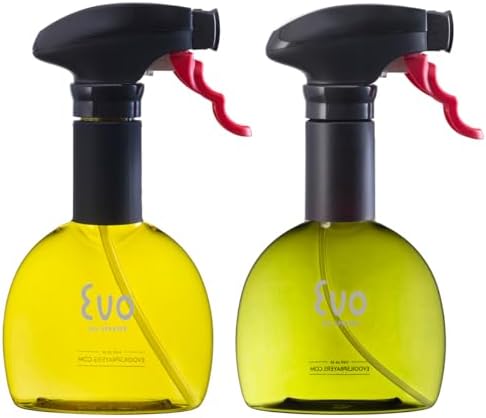
- Evo’s Mini Non-Aerosol Oil Sprayer Bottles spray without harmful propellants or chemicals, require no pumping or priming…
- Made with food-safe, Latex, BPA, and DEHP-free materials; award-winning design by Michael Graves Design Group (MGDG); se…
- Nozzles rotate horizontally or vertically to spray a unique fan-shape; cover more surface with 1/4-teaspoon for healthy …
The Engineering Reality
Instead of building internal pneumatic pressure, the Evo relies purely on a mechanical, ergonomic trigger designed by the Michael Graves Design Group. The physics here are simple but highly effective: every full pull of the trigger dispenses exactly 1/4 teaspoon of oil.
The nozzle does not create a microscopic, floating aerosol cloud. Instead, it rotates to spray a unique, wide fan-shape, either horizontally or vertically. This mechanical ejection covers a wide surface area without requiring any pumping or priming. The 8-ounce shatterproof bottles are constructed from food-safe plastic that is free of Latex, BPA, and DEHP. Because it lacks a delicate pressure seal or microscopic internal filter, the trigger mechanism can handle thicker, heavier cooking oils without immediately gumming up.
User Experience Analysis
The Evo Mini holds a strong 4.4 out of 5 stars from over 5,552 ratings, with more than 500 units bought in the past month alone. This sustained popularity stems from its reliable portion control. User Diego Giraldo specifically verified the dispenser’s accuracy by weighing the container before and after several sprays, confirming the fan pattern provides an excellent, even application.
However, mechanical triggers have distinct failure points. The manufacturer specifies that the sprayer must be hand-washed and the trigger cleared with hot water. Diego Giraldo noted that his first sprayer stopped working immediately after its first cleaning, and the second sprayer included in the two-pack arrived defective from the factory. Conversely, heavy-duty users see different lifespans. User TCIP noted they use the sprayers daily and experienced only one pump failure after five years of hard kitchen use. The variance in longevity suggests that while the design is robust, the plastic internal springs and valves can be sensitive to washing techniques or manufacturing inconsistencies.
Trigger Control vs. Aerosol Mists
If you demand a continuous, floating mist for delicately coating light salads, this mechanical fan-spray will feel too heavy. If you want structural reliability, strict calorie control, and the ability to rapidly coat a hot skillet or air fryer basket without pumping a cap ten times, the Evo remains structurally superior to pressurized alternatives. It trades the ultra-fine mist of an aerosol for a heavy-duty, metered fan spray that actually survives the rigors of daily cooking.









[…] to a manual sprayer is a seamless transition. The expectation is that you can just pour heavy olive oil into a bottle, press a button, and get a flawless, microscopic mist forever. Commercial sprays […]