For anyone putting together a functional kitchen, the choice of the main all-purpose knife often comes down to two iconic shapes: the Western Chef’s knife, otherwise known as gyuto, and the Japanese Santoku. Both are for chopping, slicing, and dicing, but the different geometries mean these knives offer very different cutting styles. Deciding between Santoku vs. Chef’s Knife depends heavily on your preferred way of cutting and the types of food you prepare most frequently.
Compare the feel and balance of both classic chef’s knives and Santoku models:


The Chef’s Knife: Rocking and Slicing
The classic Western chef’s knife has a very pronounced curve that follows the belly of the blade down to a sharp, pointed tip.
- Expertise: This curved profile is specifically designed for the rocking motion where the tip remains on the cutting board while the rest of the blade moves up and down. This motion is efficient in mincing herbs and swiftly dicing vegetables. The sharp, pointed tip is ideal for piercing and doing fine work, such as trimming meat or making precision cuts.
- Versatility: The chef’s knife, with its blade lengths, often ranging from 8 to 10 inches, provides ample knuckle clearance and is capable of handling larger tasks, making it the globally accepted workhorse of the kitchen.
The Santoku: Chopping and Efficiency
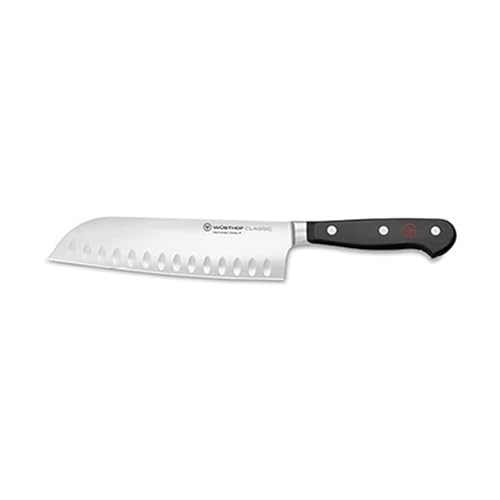
The Santoku, whose name means “three virtues” for the three foods with which it is used meat, fish, and vegetables offers a flatter cutting edge combined with a spine that slopes downward to meet the edge at a rounded tip.
- Authoritativeness: The flat profile encourages a chopping motion where the blade is lifted straight up and down rather than the Western rocking action. This motion is great for processing vegetables in rapid succession and is preferred by many cooks who like to have more control during vertical cuts. The shorter blade, normally 6 or 7 inches, allows for better maneuverability.
- The Granton Edge: Many Santoku knives have a Granton edge, which is small indentations near the edge. These create air pockets that help greatly reduce sticking when slicing starchy or moist foods like potatoes or cured meats a key advantage when considering Santoku vs. Chef’s Knife.
Choosing Your Style: Santoku vs Chef’s Knife
They’re both great for general home use. The decision largely depends on your technique. If you do a rocking motion most of the time, then the Chef’s knife is an extension of your arm. If you like the straight vertical chop and like a lighter, shorter blade for quicker prep, the Santoku is very suitable.
read more: Victorinox Fibrox Pro: Why This Chef’s Knife is the Industry Standard







[…] Related article: Santoku vs. Chef’s Knife: Which Blade Shape is Best for General Use? […]
[…] a good, reliable chef’s knife that doesn’t break the bank involves trade-offs between steel quality, handle ergonomics, and […]
[…] home cooks use a chef’s knife for everything. It works, but it was not designed for the repetitive vertical chopping that […]