The most common catastrophe in home butchery is not cutting a finger; it’s destroying a $200 chef knife by striking a chicken bone.
Standard kitchen knives are designed for slicing, whereas cleavers are designed for chopping. But buying “a cleaver” is simply not good enough. The market is full of thin “Chinese Chef Knives” masquerading as bone choppers. Hit the wrong one against a beef rib, and it’ll chip instantly.


To choose the right tool, you need to understand three technical metrics: Spine Thickness, Mass, and Rockwell Hardness. We have grouped them by physics and usage below.
1. The Heavyweight: Western Bone Cleaver
For processing dense protein structures beef ribs, pork shoulders, or frozen meats you count on Momentum, not sharpness.
- Physics: $Force = Mass \times Acceleration$. A lightweight cleaver requires you to swing your arm harder to cut through cartilage, which leads to loss of control. A heavy cleaver (1.5 lbs+) creates its own kinetic energy. You simply lift and let gravity drive the wedge through the bone.
- Spine Thickness: Should be 4mm to 6mm. This will turn the spine into a splitting wedge, which protects the edge from rolling.
- Steel Hardness: Ideally softer (54-56 HRC). Soft steel is tough; it will dent rather than shatter if hitting a femur.

- Premium Durability And Quality – Super Sharp Cleaver Knife is made of high-quality stainless steel that resists rust, co…
- Multi-purpose Cleaver’s Knife – Designed to be multipurpose knife for professional applications and it can be used for y…
- Extremely Sharp Edge – Sharpness is key to achieving the best cuts and this is evident in the knife’s blade which is qui…
2. The Middleweight: Poultry and Lobster
Not every task requires a 2-pound beast. Whole chickens, duck, or lobster shell splitting requires a balance between agility and power.
- Hybrid Role: These blades are often lighter (approx. 0.8 to 1 lb) with a thinner spine (2.5mm to 3.5mm).
- Usage: It is sharp enough to slice through meat cleanly but has enough backbone to pop through joints and smaller rib cages. However, they should not be used on heavy beef bones.

- Multi-purpose Cleaver: The classic 7″ Chinese kitchen knife easily handles your everyday kitchen needs such as chopping,…
- Professionally Ground Sharp Blades: Hand sharpened by experienced artisans. The kitchen knife has an 18° angle on both s…
- Extremely HC Outstanding Stainless Steel from Japan: This imarku Meat Cleaver is forged from excellent Japan imported hi…
3. The Lightweight: Chinese Vegetable Cleaver (Cai Dao)
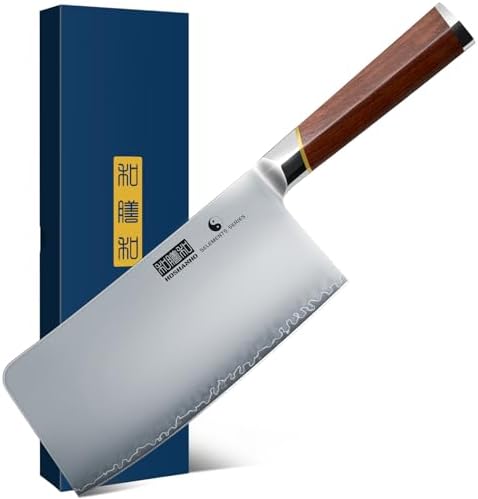
This is the most misunderstood tool in the kitchen. Although it is rectangular like a cleaver, it is mechanically a Chef’s Knife.
- Blade Geometry: The spine is razor-thin (2mm or less). The edge angle is acute (often 15 degrees).
- Usage: It is designed for push-cutting vegetables and slicing boneless meats. The broad blade is excellent for scooping up prep work from the cutting board.
- Warning: Never strike a bone with this. The hard, thin steel will chip immediately.

- 【Excellent Sharp Edge】The sharp blade with 15° on each side allows for clean and precise cutting, and the hardness is as…
- 【Precision Forged Japanese Steel】This meat cutting knife is made of our specially formulated Japanese 10Cr15CoMoV stainl…
- 【Ergonomic Handle Design】The handle of our chef’s knife is meticulously crafted for both comfort and control, designed f…
4. Critical Safety Feature: The Handle
Regardless of the weight class, the handle construction is nonnegotiable.
- Full Tang: The metal of the blade must extend all the way through the handle. In a chopping tool, the stress on the neck (bolster area) is immense. Partial tangs will eventually snap, sending the blade flying.
- Grip Material: When butchering, hands get covered in fat and moisture. Avoid smooth, polished handles. Look for textured composites (like G10 or Pakkawood) or textured polymers that provide traction when wet.
Verdict: Matching the Tool to the Tissue
- Breaking Beef/Pork: Prioritize Mass (Weight). Get the heaviest tool you can safely lift.
- General Prep: Prioritize Geometry (Thinness). A vegetable cleaver is the ultimate slicing machine, provided you respect its fragility.
- Chicken/Game: Go for the Middleweight. Versatility is key.
Related article: Victorinox Fibrox Pro Boning Knife Review: Why It Is The Industry Standard