
If one thing in the kitchen cabinet more than any other likes to act like a bully, it would be the colander.
You know the problem. You have the typical stainless steel or hard plastic colander. It is massive, round, and refuses to stack alongside anything else in your kitchen. You attempt to pile a pot on top of it, and thus topples the whole lot over. It may as well render an entire shelf useless for the storage of a tool that you use a mere two times a week.

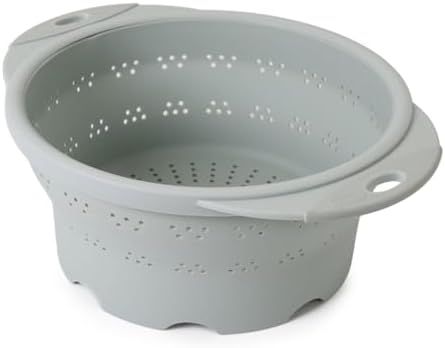
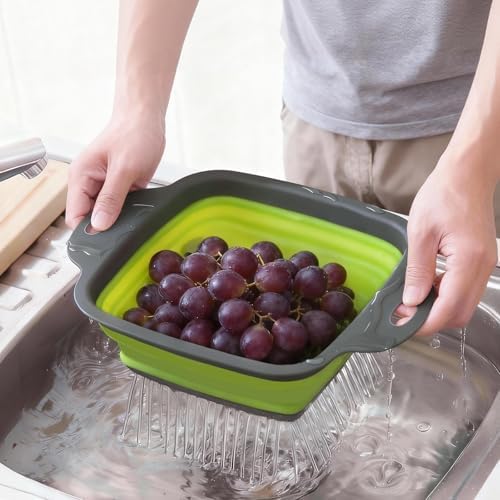
This is all the more reason why collapsible silicone kitchen utensils have become so popular. But is it true that soft silicone is reliable when it comes to boiling pasta? This is what you need to know.
The Space-Saving Magic
The first reason to consider buying a collapsible strainer has to be geometry.
“Regular” colanders come in the form of inflexible bowls. “Collapsible” colanders have a hard plastic frame and “base,” and these elements are linked by accordion folds of silicone. To store the colander after you’re done with it, you press down on it and the colander collapses from a 5-inch deep bowl into a 1-inch disk.
- The Result: You can position it vertically alongside cutting boards or layer it below a dinner plate. In a small apartment such as mine, it opened up enough room in a cabinet for a whole blender.
Quick Comparison: Metal versus Silicone
For those torn between the two, here is a breakdown.
- Metal Colanders: Drain quickly and last forever but consume enormous storage space.
- Collapsible Silicone Strainers: Are ultimate space-savers, usually dishwasher safe, but drain slowly because there are less holes, as well as tend to collapse suddenly if packed with heavy materials.
Where Silicone Struggles (The Cons)
I promised truth, so here is the annoyance not listed on the box: Drainage Speed.
In a wire mesh strainer, there are holes all around, including the bottom and sides. Water disappears immediately. In the most common type of collapsible strainers with a flat bottom, only holes are there on the bottom surface.
- The Problem: In pouring a massive amount of spaghetti into the colander, water accumulates for a brief moment prior to draining out. It is effective but not instantaneous.
- The Risk: Because of the flexibility of the sides, if you turn on a big pot of potatoes too much, sometimes the strainer will attempt to fold in on itself. You have to treat it a little more gently than a metal strainer.
read more: Why I Finally Ditched My $10 Grocery Store Thermometer
Cleaning and Durability
There is a myth about these kinds of items being hard to clean. It is actually easier. They are dishwasher safe, and because they flatten out, they go down in the dishwasher bottom rack as though they were a plate, as opposed to something akin to a large metal bowl.
However, the longevity of the material is limited. With heavy use involving constant folded/unfolding for a few years, the material may finally break down along the seams. Whereas a metal colander is for the taking and is ‘buy it for life,’ the silicone material is a ‘buy it for a few years’ item.
Is It Worth It?
If you have the kitchen of the giant super-rich, and there are an infinite number of cabinets, then stick with the metal. Trust me, the drainage is better.
But if you are fighting for every inch of cabinet space, then the sacrifice is absolutely worthwhile. Giving back 5 seconds of drainage time for an entire shelf is a trade-off I will make every time.
read more: Stop Guessing: A Real Look at the Alpha Grillers Instant Read Thermometer








[…] and the chef’s knife are particularly illustrated in how the Cooper Hewitt Museum situates the kitchen as the laboratory of human ingenuity. The kitchen bridges the “Origins” of the object and the “Chronicle” of […]