
A lot of home cooks and even first-year culinary students use the terms boning knife and fillet knife interchangeably. Although both are designed for protein processing, they are not interchangeable.
It’s a question of blade physics, more specifically the relationship between blade thickness, flexibility, and target-bone or skin. Trying to take that pork shoulder apart with a limber fillet knife will leave you without leverage, apt to hurt yourself; a stiff boning knife used on that trout will shred the flesh.

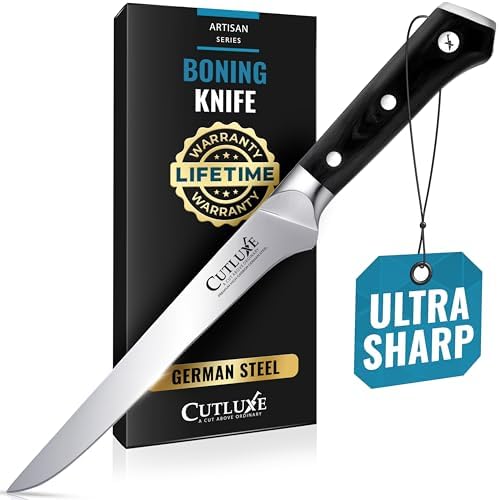
The Core Difference: Rigidity vs. Flexibility
The main technical differentiator is the “flex rating” of the steel.
1. The Boning Knife (Rigid to Semi-Stiff)
A boning knife is engineered to separate meat from the carcass. It generally features a thicker spine (often 2.0mm+) to withstand the lateral force required to pop joints or scrape against hard bovine and porcine bones.
- Target: Beef, Pork, Lamb, Chicken joints.
- Geometry/Shape of Blade: Usually 5 to 6 inches; straight or slightly curved.
- Action: Stiffness permits the user to apply force with the tip, to sever cartilage, without the blade bending unpredictably.
2. The Fillet Knife (High Flexibility)
A fillet knife is a sub-category of boning knives dedicated to fish only. The blade is ground much thinner usually less than 1.5mm to accommodate a 15-to-20-degree flex.
- Target: Fish; skin and de-bone it.
- Blade Geometry: 6 to 9 in., pronounced trailing point.
- Action: The blade should act like a spring, contouring perfectly along the backbone and skin of the fish to maximize yield.
Which One Do You Need?
- Buy a Boning Knife If: You process whole chickens, trim fat caps off briskets, or debone legs of lamb. You need tip control and stiffness.
- Buy a Fillet Knife If: You break down whole fish. You need the blade to glide parallel to the cutting board to remove skin.
Our Top Picks: Precision & Performance
We have analyzed the metallurgy and geometry of the top contenders, and below are specific tools that meet our technical requirements for edge retention, flexibility, and ergonomic grip.
1. Best Overall Boning Knife: Victorinox 6-Inch Curved Fibrox Pro
This is widely regarded as the commercial industry standard for a reason. The semi-stiff blade geometry offers the perfect middle ground: rigid enough to glide along the bone of a pork shoulder without wandering, yet flexible enough to maneuver through joints.

- Blade type: curved/narrow
- With blade of stainless steel
- CARE AND USE: Follow these simple tips to get the longest life out of your knife; While Fibrex Pro knives are dishwasher…
- Key Feature: The patented Fibrox handle is textured to prevent slipping even when covered in fat or moisture, a critical safety feature for high-volume butchery.
- Best For: General deboning of poultry, pork, and beef.
2. Best Precision Fillet Knife: HOSHANHO 7-Inch High Carbon
This Japanese-style blade is better for users who place more importance on edge retention rather than brute toughness. Constructed from High Carbon Stainless Steel, it achieves a hardness that accommodates a razor-thin edge geometry.

- 【Premium High Carbon Steel】This professional fish fillet knife is made from high-quality Japanese stainless steel 10Cr15…
- 【Excellent Cutting Results】With a 7 inch long, thin blade, the fillet knife makes it easy to slice, bone, trim, skin and…
- 【Ergonomic Design】The ergonomic shape of the fish knife’s handle provides a more comfortable grip and reduces user fatig…
- Key Feature: The thin profile minimizes friction, allowing for surgical precision when skinning delicate fish or removing silverskin.
- Best For: Filleting fish, where the precision in trimming should leave zero meat wastage.
3. Best for Large Primal Cuts: Cutluxe 10″ Cimeter Breaking Knife
A standard 6-inch knife lacks the necessary leverage when dealing with large game or whole primal cuts, such as a full strip loin. This 10-inch Cimeter is intended for “breaking” that is, the process of reducing large carcasses into sub-primal cuts.

- PREMIUM PERFORMANCE – Perfectly engineered carving butcher knife tapered to a razor-sharp edge for effortless breaking d…
- RAZOR-SHARP GRANTON BLADE EDGE – Hand sharpened edge at 14-16 degrees per side for maximum sharpness & edge retention en…
- FULL TANG ERGONOMIC DESIGN – Luxury pakkawood handle that is triple-riveted for sure grip and absolute stability that en…
- Key Feature: The curved “scimitar” shape enables long, single stroke cuts that eliminate the jagged “sawing” marks often left by shorter blades.
- Best For: Breaking down deer, large briskets, or whole ribeyes.
4. Best for BBQ & Slicing: Cutluxe Carving & Boning Set
Processing cooked meat requires different mechanics from raw butchery. This set uses German Steel that is tempered for toughness, designed to slice through hot muscle fibers without shredding the bark on a brisket or the skin on a roast.
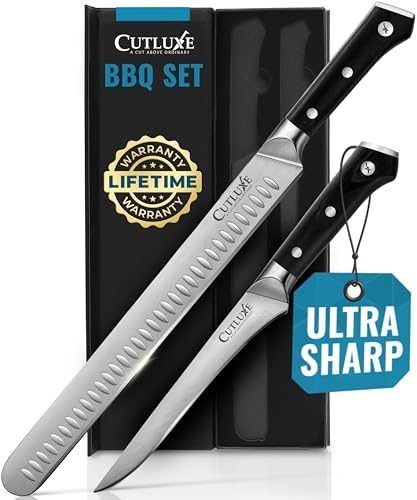
- PREMIUM PERFORMANCE: This BBQ knife set includes a 12″ brisket slicing knife and a 6″ boning knife, designed for precise…
- RAZOR-SHARP GRANTON BLADE EDGE: Experience premium performance with razor-sharp granton blades on both knives, reducing …
- PERFECT GIFT: This slicing knife for meat cutting is the ideal gift for BBQ enthusiasts and chefs. Its exceptional quali…
- Key Feature: The hollow-ground edge also known as grantons forms air pockets that prevent meat from sticking to the blade when slicing.
- Best For: BBQ enthusiasts, brisket slicing, and cooked roasts.
Recommended read: HOSHANHO 7-Inch Fillet Knife Review: Steel Performance







[…] Related article: Boning Knife vs. Fillet Knife: Which to Use and Our Top Picks […]
[…] just can’t fillet a delicate trout or crappie with the same rigid knife you do tuna. The blade geometry has to marry up with the species of fish to get clean yield without […]
[…] a high price tag. For cooks in the market looking for a reliable workhorse without the investment, this knife promises classic looks married to essential build features. This review scrutinizes the core claims […]
[…] Read More: Boning Knife vs. Fillet Knife: Which to Use and Our Top Picks […]
[…] Recommended read: Boning Knife vs. Fillet Knife: Which to Use and Our Top Picks […]