
If you do leave meat on the bone, stop blaming your technique. Blame your blade’s stiffness.
You just can’t fillet a delicate trout or crappie with the same rigid knife you do tuna. The blade geometry has to marry up with the species of fish to get clean yield without hacking through the ribcage. It all boils down to one important word: controlled flexibility.

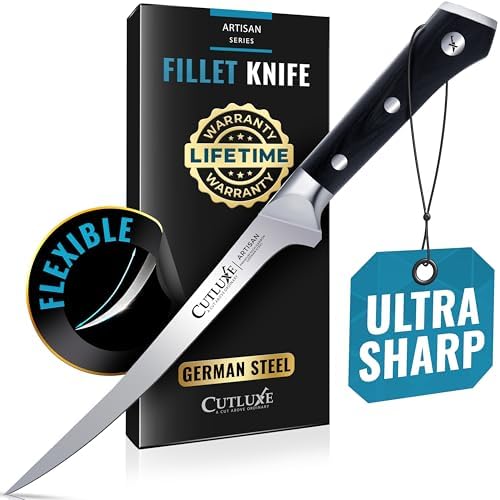

The Mechanics of Flexibility
Forget the marketing terms. In practical terms, “flexibility” is your ability to apply lateral pressure against the spine without the knife digging in or snapping back.
- High Flex (Thin Blades): A must for soft-fleshed river fish. The blade should bend nearly 20 degrees, which will enable you to flatten it completely against the skin in order not to waste the fillet.
- Stiff/Low Flex-Thick Blades: Necessary for saltwater game fish with tough scales and thick bones – like Doradol or Stripers. A flexible knife here will just wander and stick.
For the overwhelming majority of general anglers, a 7-inch “Medium Flex” Tapered Blade is literally all you will ever need in the tackle box.
Steel Selection: Saltwater vs. Freshwater
The environment determines the metal. A high-carbon chef’s knife will rust in hours on a boat.
For fillet knives, edge retention is often secondary to corrosion resistance.
- German Steel (Soft, ~56 HRC): Best for saltwater. It’s tough, bends without chipping, and resists rust. If it gets dull after 10 fish, you can hone it in 10 seconds.
- Japanese Steel (Hard, ~61 HRC): Holds an edge forever, but is brittle. One wrong twist against a hard vertebrae and the tip will snap. Save this for the kitchen, not the boat deck.








[…] to put life back into those dull knives? Explore sharpening stones and more, right […]
[…] admit it I didn’t think I’d be having views on forks and knives. And then I found a Scandinavian cutlery set, and I became the person at dinner parties who talks […]
[…] While Henckels is the “value” brand compared to their premium Zwilling line, the DNA is the same. The blades are made from High-Quality German Stainless Steel. […]