
The biggest problem with most “beginner” knives that are marketed towards children is that they can all be broken down into two terrible categories, which are either a dull piece of plastic that a child cannot use to cut wood, or a full-fledged knife that is far too sharp for a child’s small hands.
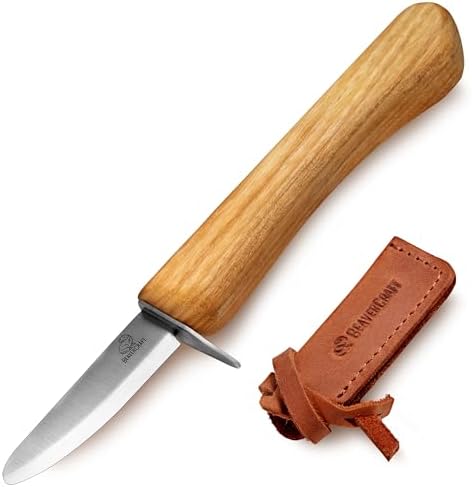
- Safe and Reliable Whittling Knife for Kids: Our wood carving knife for kids is completely safe due to its thoughtful des…
- Kids Whittling Knife with Ergonomic Design: The knife has a compact and convenient handle design that provides a secure …
- Wood Carving Kids Knife Leather Sheath: A whittling knife for kids comes in a genuine leather blade sheath for maximum s…
The problem that the BeaverCraft C1 Kid Whittling Knife is trying to address is the middle ground. It is meant to be a real woodworking tool, with enough sharpness to be safe but with enough safeguards against common injuries. We discuss whether this product has the best balance of safety and performance for a beginner child.
It’s Sharp, and That’s Good
There is a common misperception that a blunter knife is a safer knife. The use of a blunt knife for whittling results in too much pressure being applied, which causes the knife to slip.
The blade is composed of High-Carbon Steel, which is not stainless. This contributes to it going extremely sharp with a long life span on that sharpness. It helps the child cut with ease, without applying force on the blade, as it progresses through the wood. The learning curve associated with this tool is technique-based, not tool-based.
The Mechanical Safety Features
BeaverCraft didn’t only reduce the size of an adult knife but changed the geometric angles for safety reasons.
The Rounded Tip: The most common problem beginners encounter is a puncture wound from a slipped tip. The C1 has a rounded, intentionally blunted nose tip. It’s not easy to poke someone with it, but with the straight edge, people still cut pretty effectively.
The Handle Size: The handle is made from Ashwood, which is a very robust wood. The size is also smaller compared to that of a typical carving knife. This is to make sure that a child, whose hands are small, is able to encircle the blade with his fingers in order to lock the blade in place as he is cutting, hence ensuring that it doesn’t turn.
Maintenance as a Teaching Minute
This is high-carbon steel, therefore it is not as resilient as a kitchen knife might be. It rusts when it is moist and dirty. This means that the user has to maintain the blade’s cleaning and stropping.
Although this might appear to be a negative, especially when it is compared to modern knives that can all be typically considered “disposable plastic cutlery,” it is a great way to instill discipline. The possession of such a blade instills how to respect professional blades, not that typically used for plastics.
Who Should Start Here?
If what you are looking for is a “toy” that your child can entertain him/herself with while unsupervised, that is NOT what you are looking for. This is a real blade that a child cannot use properly on his/her own.
In most cases, YES! But not if your aim is merely to teach the skill of wood carving with a tool that is forgiving of small mistakes (because of the rounded tip) but also emphasizes proper technique (because of the sharp steel), because in that regard, the best carpentry tool for a beginner is, at the moment, the BeaverCraft C1.









[…] cooking with kids. That is when they are proficient enough to chop a cucumber using their plastic nylon knife but the moment they try to cut a raw carrot or an apple with skin, this plastic blade just slips […]
[…] Any parent who has a toddler or preschooler who does no less than drags a chair over to the counter every time he or she starts chopping vegetables knows this. You want them to learn, but the anxiety of handing a sharp metal blade to a 4-year-old is real. […]